Arrange a real meeting time in Spanish
Whenyou choose a plan with your partner
Arrange a real time in Spanish; carry out the meeting.
- Window
- Within two weeks.
- Mission steps
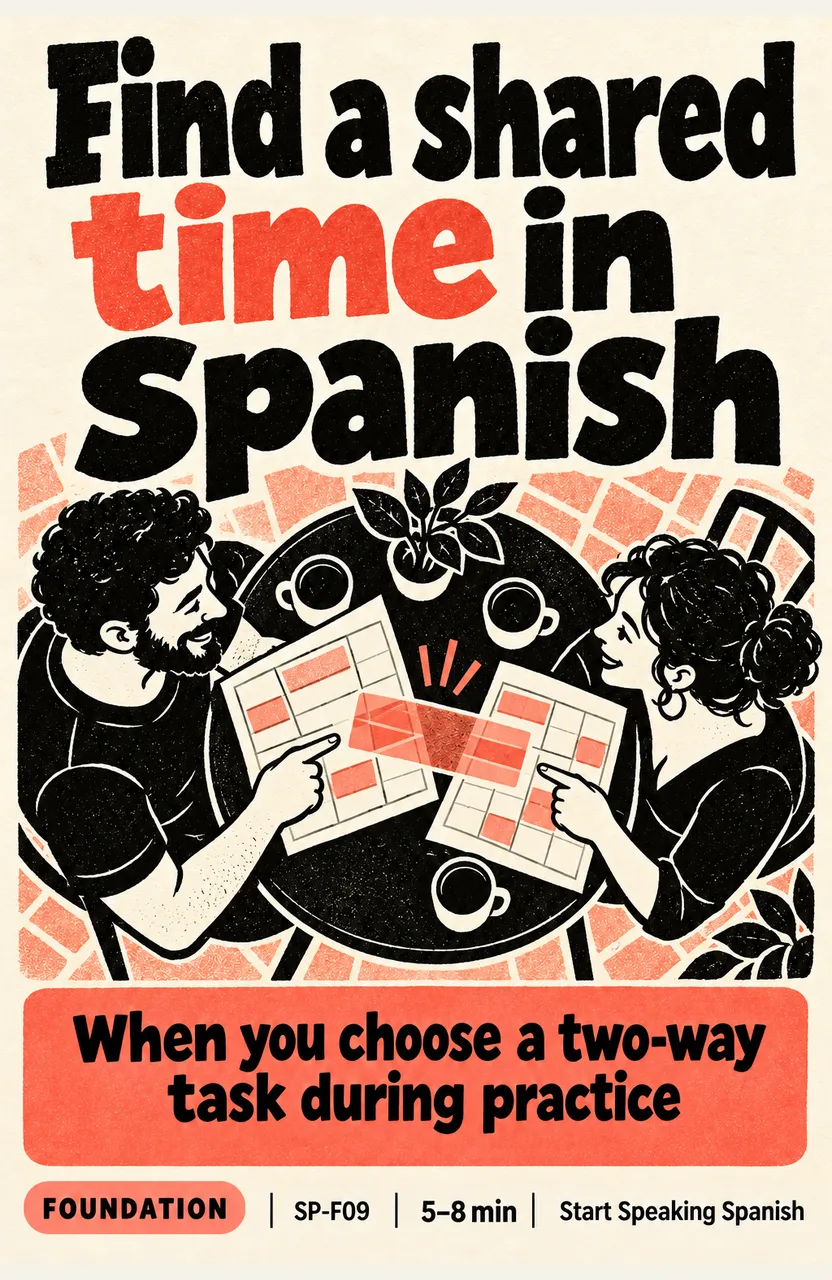
- Confirm day/place, time zone and a.m./p.m. in a shared language; each choose two feasible times.
- Ask “¿A las seis?” (At six?). Reply “Sí” (Yes) or “No. ¿A las siete?” (No. At seven?). Confirm aloud and in both calendars.
- Finish
- Both understood the same feasible time and the meeting happened.
- Adapt
- Try a five-minute call. Renegotiate clashing times; unanswered plans remain unfinished.
Start tiny
Choose the activity and day.
SafetyMeet new contacts in public; confirm important logistics in a shared language.
Council of Europe (2020), CEFR Companion Volume, oral interaction, clarification and compensation descriptors. Read the source ↗ Tian, L. & Jiang, Y. (2021), L2 Proficiency Pairing, Task Type and L1 Use: A Mixed-Methods Study on Optimal Pairing in Dyadic Task-Based Peer Interaction. Frontiers in Psychology 12, 699774. Read the source ↗ The Open University, Getting started with Spanish 3, Week 3, activity 10, invitation dialogue and time choices. Read the source ↗ — This applies the shared-time practice to an actual arrangement; the mission and two-week window are editorial, not evidence of general proficiency.
Challenge: A bounded mission with an observable finish, supported by the practices you use.