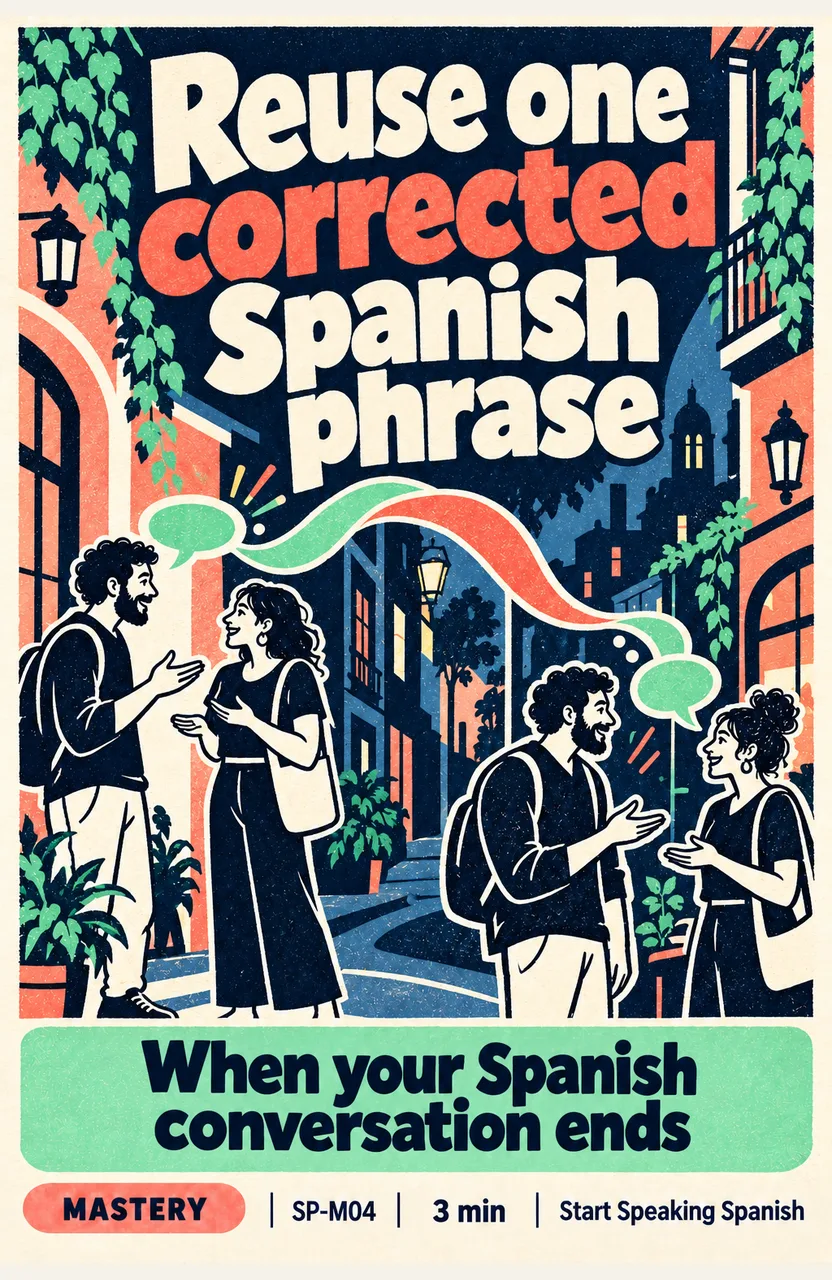
Retest a Spanish word they misheard
Whenyour partner mishears a word you say
Check which word your partner heard. Ask for a model of your intended word; copy one sound or stress change. Use it in a new reply next exchange, without showing the text. Ask which word they heard and keep or adjust the change.
- Try saying
- Ask “¿Cómo se pronuncia?” (How is it pronounced?). For “café” (coffee), try the model in “Me gusta el café” (I like coffee). Retest the intended word in a different reply next time.
Start tiny
Ask for one spoken model of the word.
When it slips
If your partner cannot explain or model the word reliably, check a teaching audio or competent speaker. Leave the correction pending rather than inventing it.
Saito, K. & Plonsky, L. (2019), Effects of Second Language Pronunciation Teaching Revisited: A Proposed Measurement Framework and Meta-Analysis. Language Learning 69(3), 652–708. Author-hosted manuscript: Read the source ↗ Maricopa Community Colleges, Español 101, Capítulo 1, introductions, numbers and pronunciation. Read the source ↗ SpanishDictionary.com, Ask for Clarification in Spanish, original lesson and bilingual examples. Read the source ↗ — Pronunciation teaching research supports targeted instruction more clearly than broad spontaneous gains. This informal listener-identification loop is a substantial editorial adaptation; accent similarity is not the criterion.
Mastery: Inspect your work, apply a specific correction in later practice and check whether it helped.