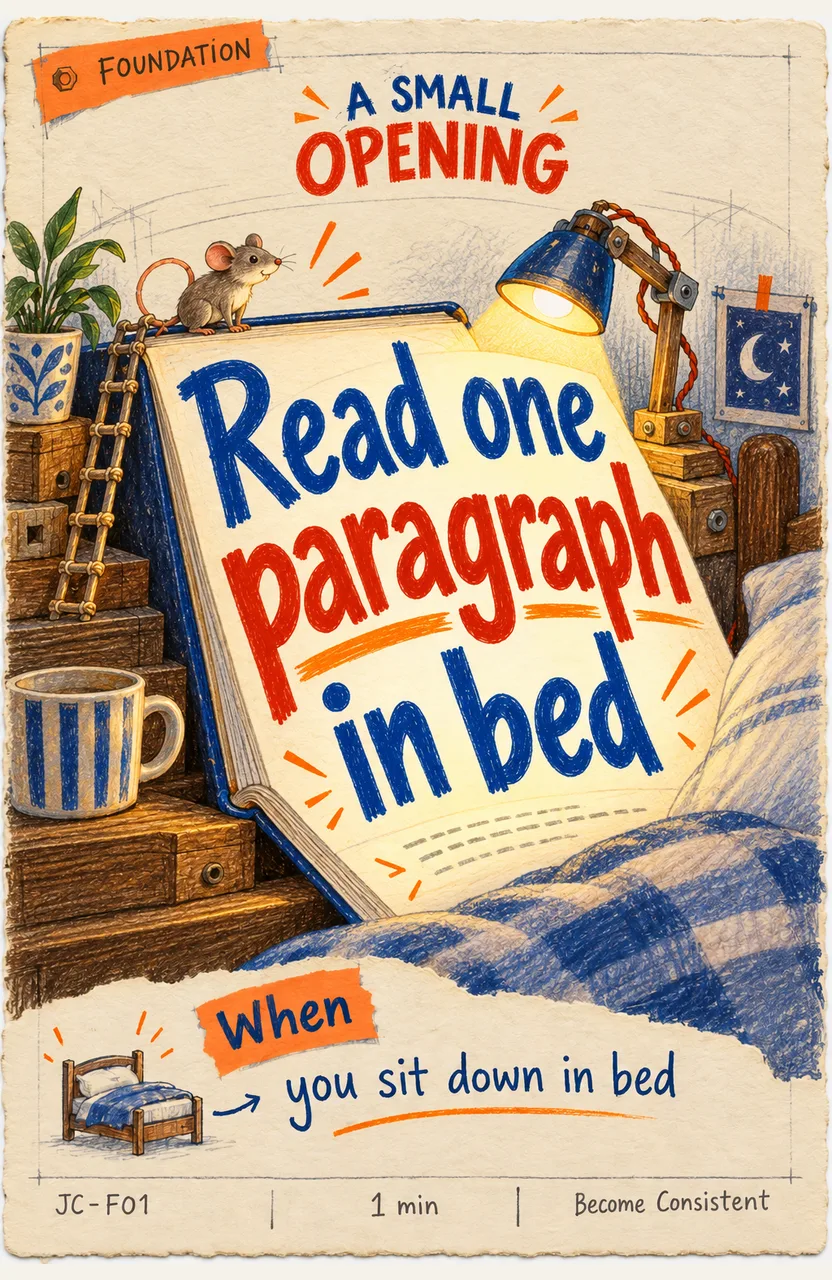
JC-F011 minRead One Paragraph After Sitting Down in Bed
Person deck · 20 cards · prefix JC
Become Consistent
Stop starting over and keep one practice going.
You've restarted the same good habit more times than you can count: a strong week, a missed day, then the whole plan quietly drops away.
- Foundation 8
- Growth 6
- Mastery 4
- Challenge 2
13 sources citedCard evidence: 3 A · 17 C. Grades describe evidence, not deck quality.
Is this deck for you?
Where it takes you.
Turn fresh starts into practices that fit your life: clear cues, workable setups, useful feedback, quick returns and commitments you can keep.
From
Starting over again and again
To
Keeping one practice going with clear cues, ready setups and quick returns
What the cards have you do
- Write one cue sentence: “After [existing action], I will [small practice] at [place],” using a cue that happens often enough.
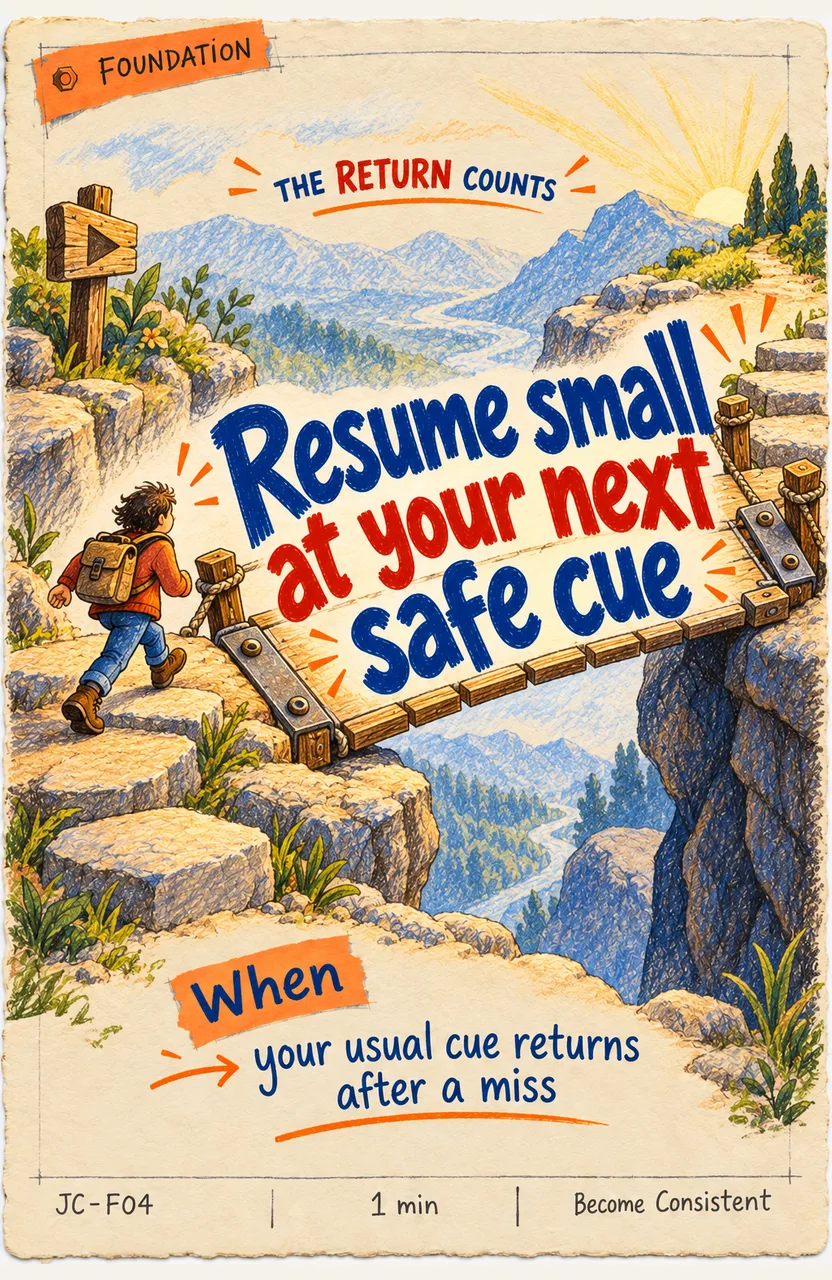
- After a miss, write the concrete obstacle and resume small at the next safe cue, leaving catch-up work behind.
- Put your phone elsewhere and leave your first tool ready, so starting takes less effort next time.
- Review your practice weekly and test one change, or ask someone for two weeks of honest done/missed check-ins.
The world of this deck
Four ways to use this deck.
The consistency workshop: ingenious everyday contraptions evolve from pencil prototypes through bold prints and polished instruments to luminous public experiments.
Foundation
Rough ivory sketchbook prototypes; cobalt graphite and vermilion pencil, orange paper accents.
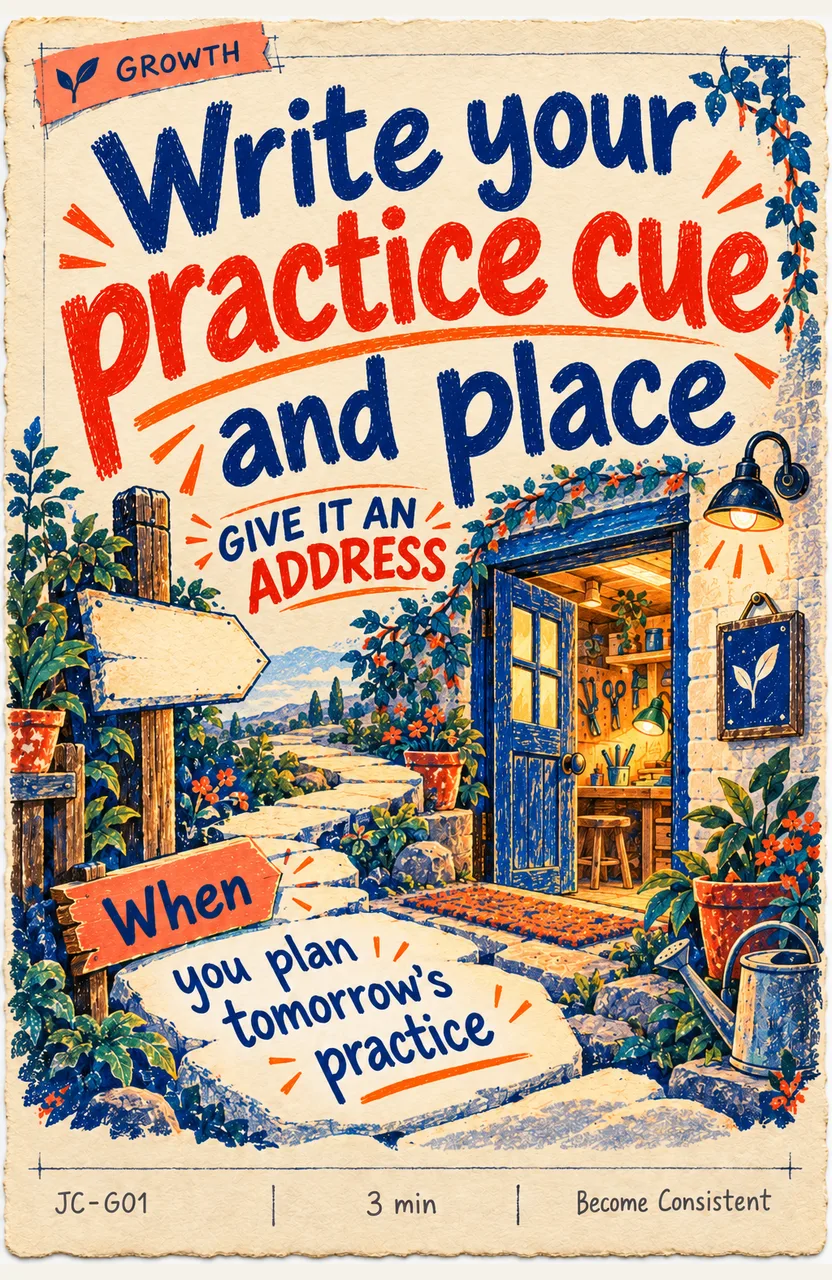
Growth
Built mechanisms in cobalt and coral screenprint, visible registration and bold cut shapes.
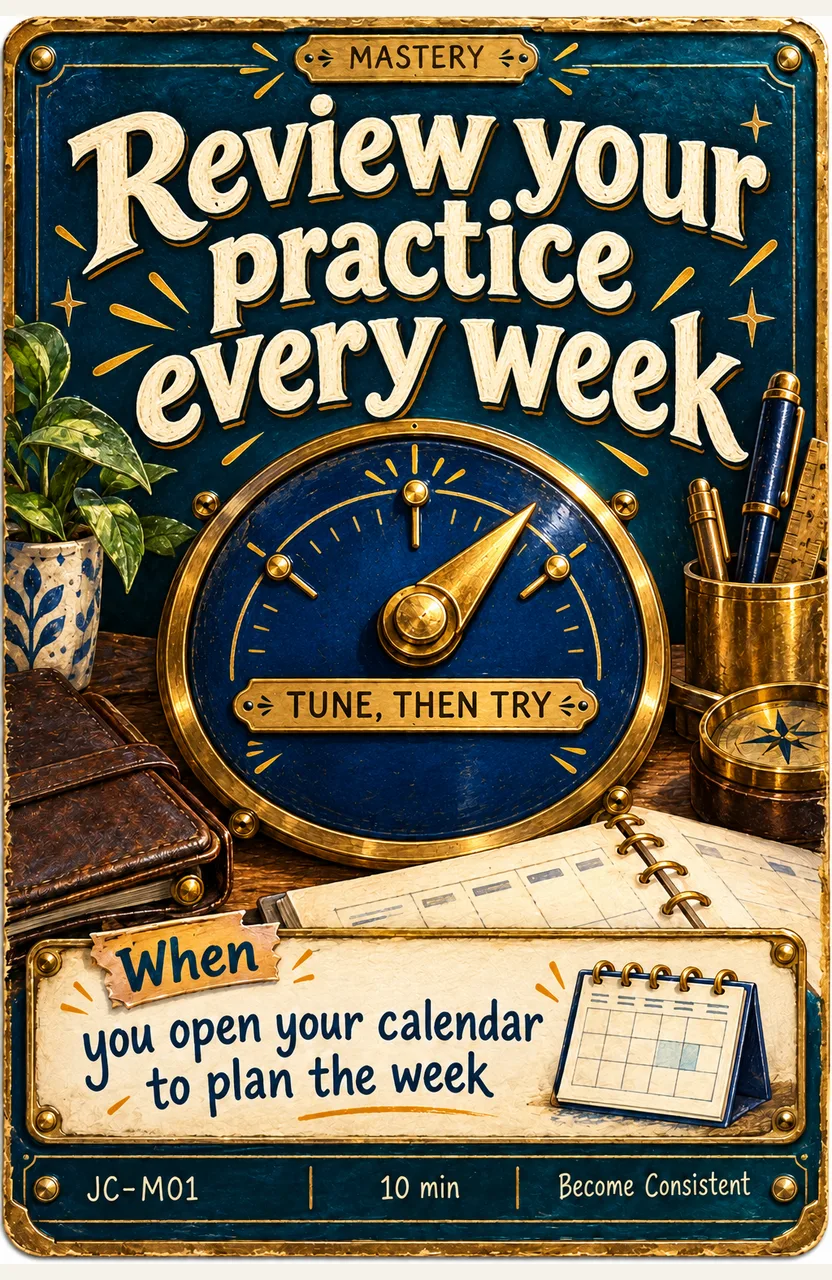
Mastery
Finished instruments: deep teal enamel, cream lettering and restrained brass detail.
Challenge
Wild experiments: midnight violet, luminous orange and turquoise, oversized painted lettering.
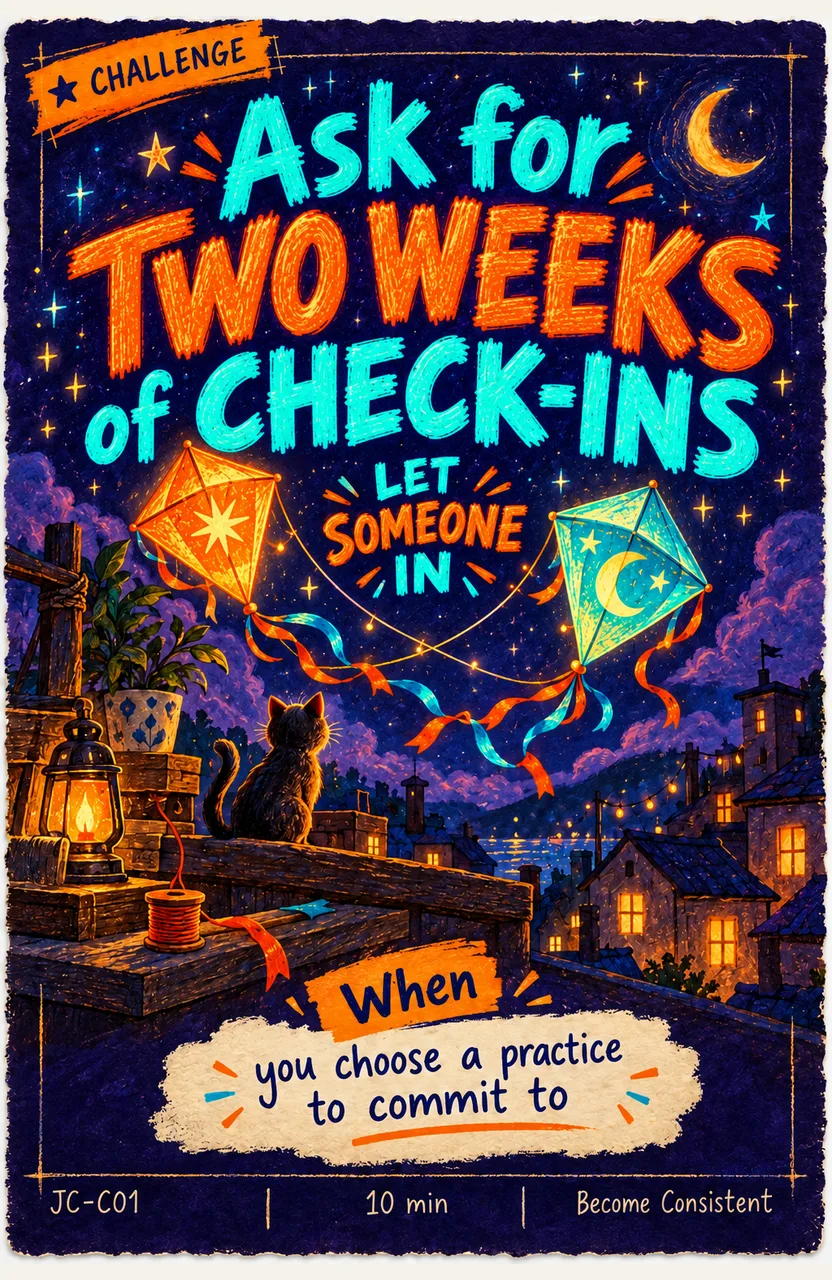
Warm, concrete and lightly mischievous. A practical workshop companion who takes interruptions seriously.
The wall
All 20 cards.
Choose recurring practices that work together, or take on a special mission. Tap any card to flip it.
20 cards · tap a card to flip it
Foundation 8
Small recurring actions with little setup. Choose anchors that fit your day.
JC-F0310 secMark One Box Immediately After Your Practice
JC-F0530 secPut Your First Tool Back Ready After Use
JC-F061 minWrite One Obstacle After a Missed Practice
JC-F0720 secName One Immediate Benefit After Your Practice
JC-F081 minChoose One Practice Before Adding Another
Growth 6
Practices that need preparation, a recurring slot or a useful tool.
JC-G013 minWrite a Cue and Place for Your Practice
JC-G035 minPlay a Favorite Playlist While Doing a Chore
Mastery 4
Practices you develop over weeks through skill, planning and trade-offs.
Challenge 2
A bounded mission with a clear finish. It can combine practices over days or weeks.
Start with your situation
Ways into this deck.
Find a useful first step, with related cards from across the library.
18 cards · draft
How do I decide what still fits after my life changes?
Separate what you know from what is still open, review goals and roles against current conditions, and try a next direction at a scale you can choose. You can keep, adapt, pause or stop; none of these practices is a required stage.
13 cards · draft
How can I connect with my young child through play and talk?
Begin with a response, a richer phrase or a moment of listening. Add one shared game or picture-book conversation when it fits. With a baby, follow a sound or gesture; with a toddler, join their exploration; with a preschooler, let their ideas lead. A small everyday exchange can be worth returning to.
9 cards · draft
How do I restart work with other people?
Check that the shared request is current, renew the arrangement and make a specific request for feedback or a realistic deadline. A handover is complete when the next person knows and accepts what they are taking on.
10 cards · draft
How do I return to unfinished work?
Find the shape of what exists, identify the working version and check the request before rebuilding from scratch. A draft can stay imperfect while you recover your place.
11 cards · draft
How do I work at a pace I can sustain?
Set an edge for the current piece, leave space in the plan and use actual experience when forecasting. Your current capacity belongs in the plan, including days when work needs to be reduced or renegotiated.
24 cards · draft
How can I get fit around a work-from-home desk job?
Use GF-M05 for one supplied strength round on Monday and Thursday. Walk GF-G08 on Tuesday, Wednesday and Friday; start with 5–10 minutes, or use GF-F09 marching indoors. Learn chair stands, push-ups and rows from GF-F07, GF-F08 and GF-G07. Scale the version on each back. The tiny start keeps participation; it is not the full training dose. GF-C05 packages the first week. Pick optional additions later, rather than doing all twenty cards every day. Build gradually toward adult activity guidance.
11 cards · draft
How can I make my practice fit my day and surroundings?
Use the routine already happening, prepare the first tool and edit the interruptions around it.
8 cards · draft
How do I learn from practice and keep a useful commitment?
Notice what happened, check a specific result and use reviews or a willing partner to keep adapting.
6 cards · draft
How do I restart after missing my practice?
Return at the next safe opportunity, record what got in the way and choose a workable fallback.
6 cards · draft
How do I start a practice I can actually repeat?
Choose one practice, give it an unmistakable first action and start with something you can repeat.
12 cards · draft
How can I start useful conversations with likely customers?
Begin with one welcome invitation, ask about a real recent problem and explain one useful service. Choose a few reminders; do not turn your relationships into a contact quota.
16 cards · draft
How do I make home strength progress visible?
First do useful strength work. Start with GF-F07 chair stands, GF-F08 push-ups and GF-F12 bridges, then use the ready GF-M05 round on two nonconsecutive days. GF-G07 adds a pull; optional hinge, carry, step-up and core cards broaden the practice. When one movement is consistently manageable, GF-M06 gives a small progression. GF-M08 records one actual set. GF-C06 compares the same comfortable sets after four weeks, without a maximum test or guaranteed result. The starter round is an entry, not an exhaustive exercise program.
Get the deck
Free to download. Worth printing.
The same 20 cards either way. Download and print them at home today, or get the printed edition and have them ready to pin up.
Free · digital download
Print it at home
$0
- All 20 cards, front and back
- Print on your own printer or save as a PDF
- Each card's full page online, with its source
- No account, no email
Paid · printed edition
Keep it in print
Price set before launch
- Professionally printed, full-colour fronts and backs
- Cut, stacked and ready to pin up
- QR codes that open each card's page
- Pays for the free library
Printed edition in the works · waitlist open
What's the difference between the free deck and the printed deck?
The cards are the same. The free deck is a download: open it in the print studio and print it at home or save it as a PDF. The printed edition is professionally printed, front and back, with each card's QR code, so it's ready to pin up the day it arrives.
Can I buy a printed deck right now?
Not yet. The original boxed decks are sold out, and the printed editions of the library decks are being prepared. Join the waitlist on any deck and we'll email you once when it's ready to order.
Do I have to do a card every day?
No. You can pin one card and keep at it until it sticks, or draw a card a day for variety. Both work. The point is repeating something worthwhile at a moment you already have.
What if I miss a day?
Pick it up the next time the cue comes round. In the best-known study of habit formation, missing a single day didn't measurably set people back. Every card also says how the habit usually slips and what to do about it.
Are Challenge cards required?
No. They're bounded missions with a clear finish, from one evening to a few weeks. Do one when you want a stretch, and skip any that don't fit your life or health.
From the screen to the fridge
Put the card where the habit happens.
Every deck is free to download and print at home, then pin up: on the fridge, the mirror, beside the monitor. Or get the printed edition, ready to pin up the day it arrives.