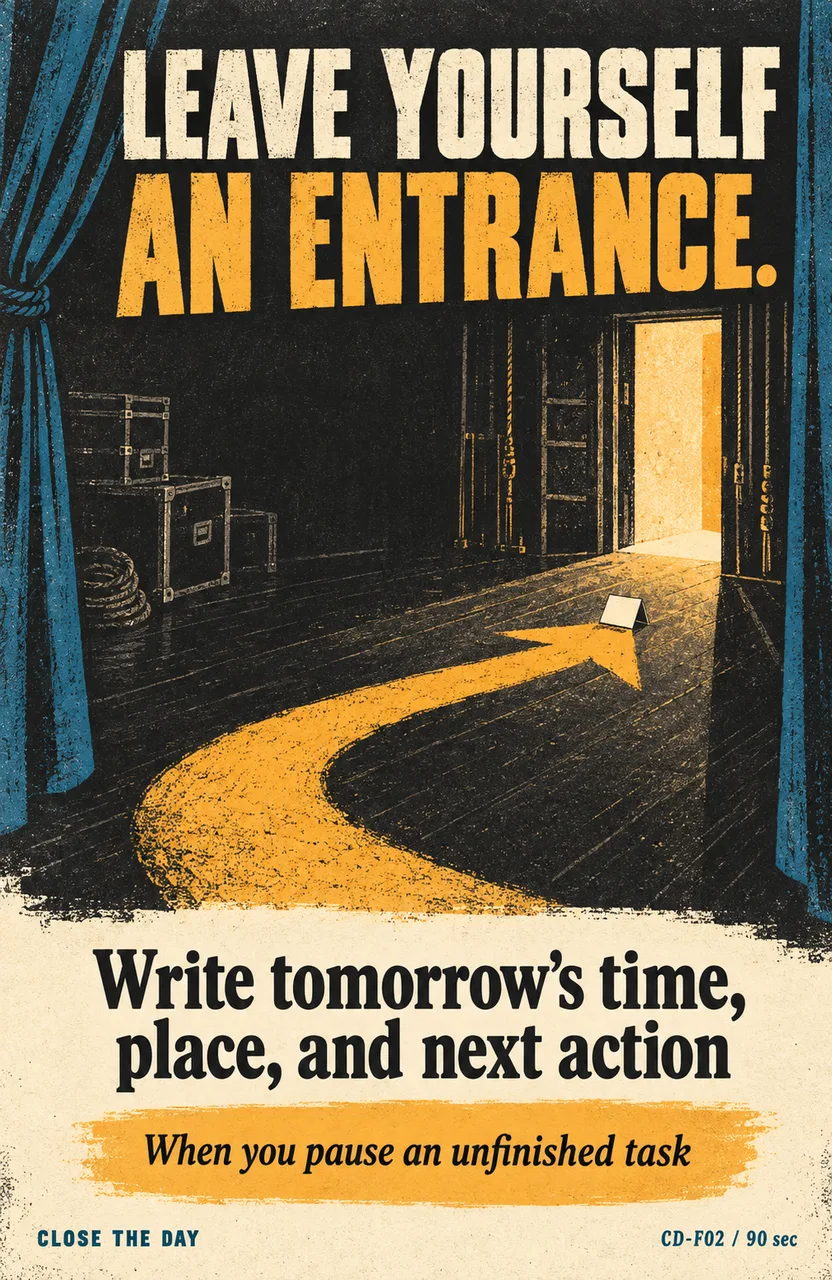
CD-F0290 secWrite a restart plan before pausing work
Topic · 13 cards · draft
Choose where your workday keeps reopening: unfinished tasks, messages, a late meeting or an evening with no activity of your own. Thirteen cards offer small stopping cues and harder boundary practices. A restart plan has direct research support; other exact recipes are practical experiments shaped by your role and team agreements.
Start here
Foundation cards: small, daily, and hard to fail. Pick one and pin it up today.
Every card for this topic
13 cards · tap a card to flip it
Small recurring actions with little setup. Choose anchors that fit your day.
Practices that need preparation, a recurring slot or a useful tool.
Practices you develop over weeks through skill, planning and trade-offs.
A bounded mission with a clear finish. It can combine practices over days or weeks.
Sources
Smit, B. W. (2016). Successfully leaving work at work: The self-regulatory underpinnings of psychological detachment. Journal of Occupational and Organizational Psychology, 89(3), 493–514. Read the source ↗
Newport, C. (2016). Deep Work: Rules for Focused Success in a Distracted World. Grand Central Publishing. Read the source ↗
Ashforth, B. E., Kreiner, G. E., & Fugate, M. (2000). All in a day's work: Boundaries and micro role transitions. Academy of Management Review, 25(3), 472–491. Read the source ↗
Kushlev, K., & Dunn, E. W. (2015). Checking email less frequently reduces stress. Computers in Human Behavior, 43, 220–228. Read the source ↗
Giurge, L. M., & Bohns, V. K. (2021). You don’t need to answer right away! Receivers overestimate how quickly senders expect responses to non-urgent work emails. Organizational Behavior and Human Decision Processes, 167, 114–128. Read the source ↗
Kreiner, G. E., Hollensbe, E. C., & Sheep, M. L. (2009). Balancing borders and bridges: Negotiating the work-home interface via boundary work tactics. Academy of Management Journal, 52(4), 704–730. Read the source ↗
Sonnentag, S., & Fritz, C. (2007). The Recovery Experience Questionnaire: Development and validation of a measure for assessing recuperation and unwinding from work. Journal of Occupational Health Psychology, 12(3), 204–221. Read the source ↗
From the screen to the fridge
Every deck is free to download and print at home, then pin up: on the fridge, the mirror, beside the monitor. Or get the printed edition, ready to pin up the day it arrives.