Topic deck · 13 cards · prefix CD
Close the Day
Stop work properly and get your evening back.
Work keeps leaking into your evening: one more email, a thought you can't park, alerts on the sofa. You'd like a clear stop without letting colleagues down.
- Foundation 4
- Growth 4
- Mastery 3
- Challenge 2
8 sources citedCard evidence: 1 B · 12 C. Grades describe evidence, not deck quality.
Is this deck for you?
Where it takes you.
Thirteen habits for ending work, making the transition, and protecting your evening. Start with small stopping cues, then practise handovers, message timing, consistent finishes and explicit team boundaries. Choose what fits your role; there is no compulsory nightly checklist.
Work keeps leaking into my evening
Finishing on purpose, handing over cleanly and keeping evenings mine
What the cards have you do
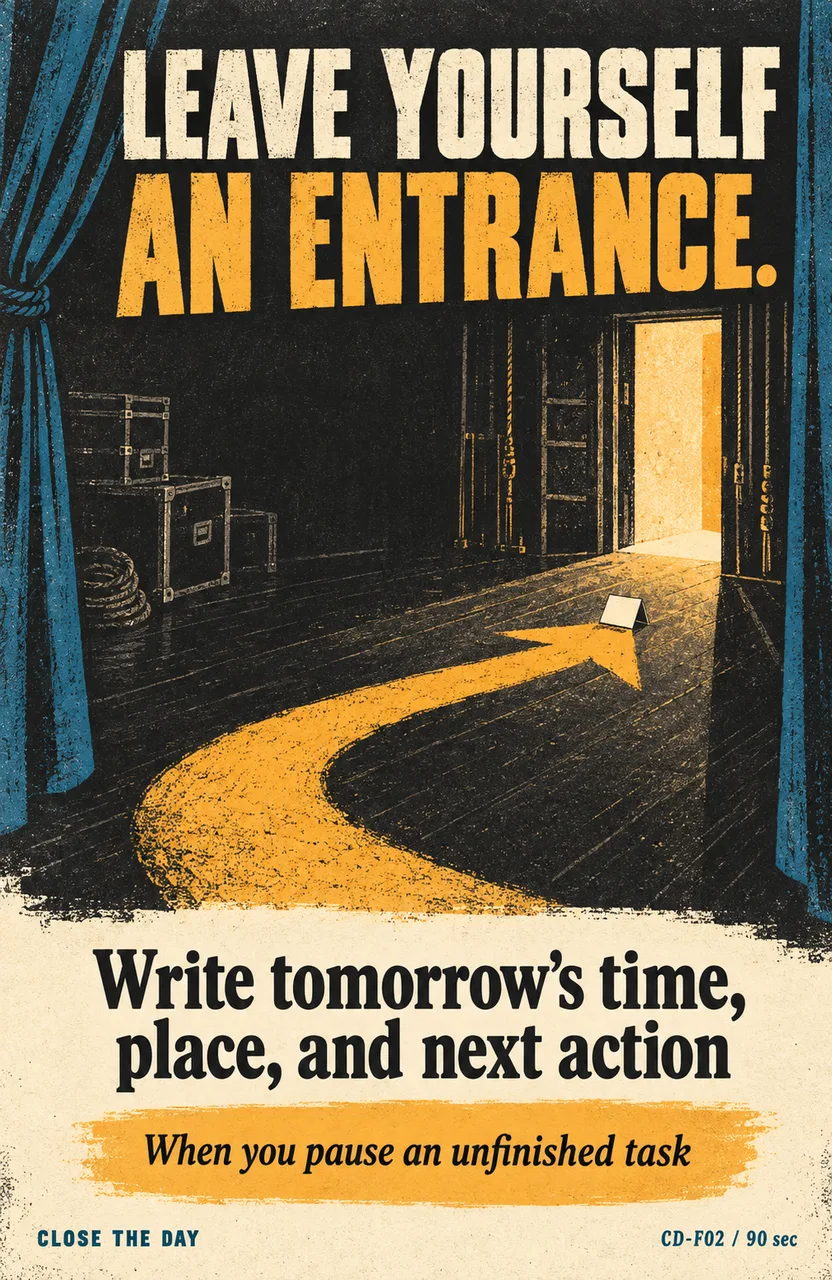
- Write tomorrow's time, place and first action beside unfinished work, so you can stop without carrying it in your head.
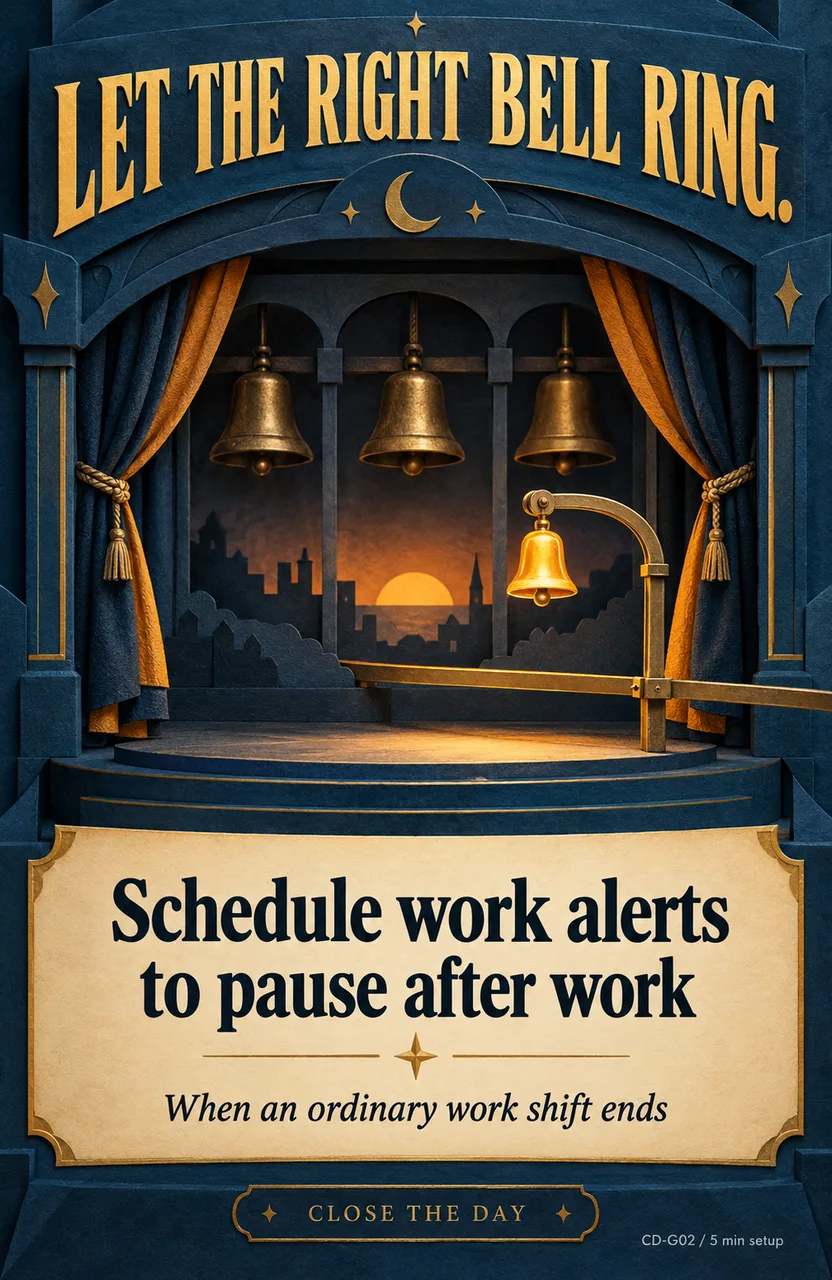
- Schedule work alerts to pause after hours, and send non-urgent evening messages for the recipient's working time.
- Get a colleague's confirmation before handing over, so nothing depends on you checking in later.
- Tell teammates when you next read off-hours requests, and which agreed route handles a genuine emergency.
The world of this deck
Four ways to use this deck.
The closing-time theatre: backstage proofs become working paper stages, finished midnight-blue and brass instruments, then unruly coral-and-violet after-show inventions. Cue sheets, costumes, dispatch machinery and stage clocks tell different stories about putting work down.
Foundation
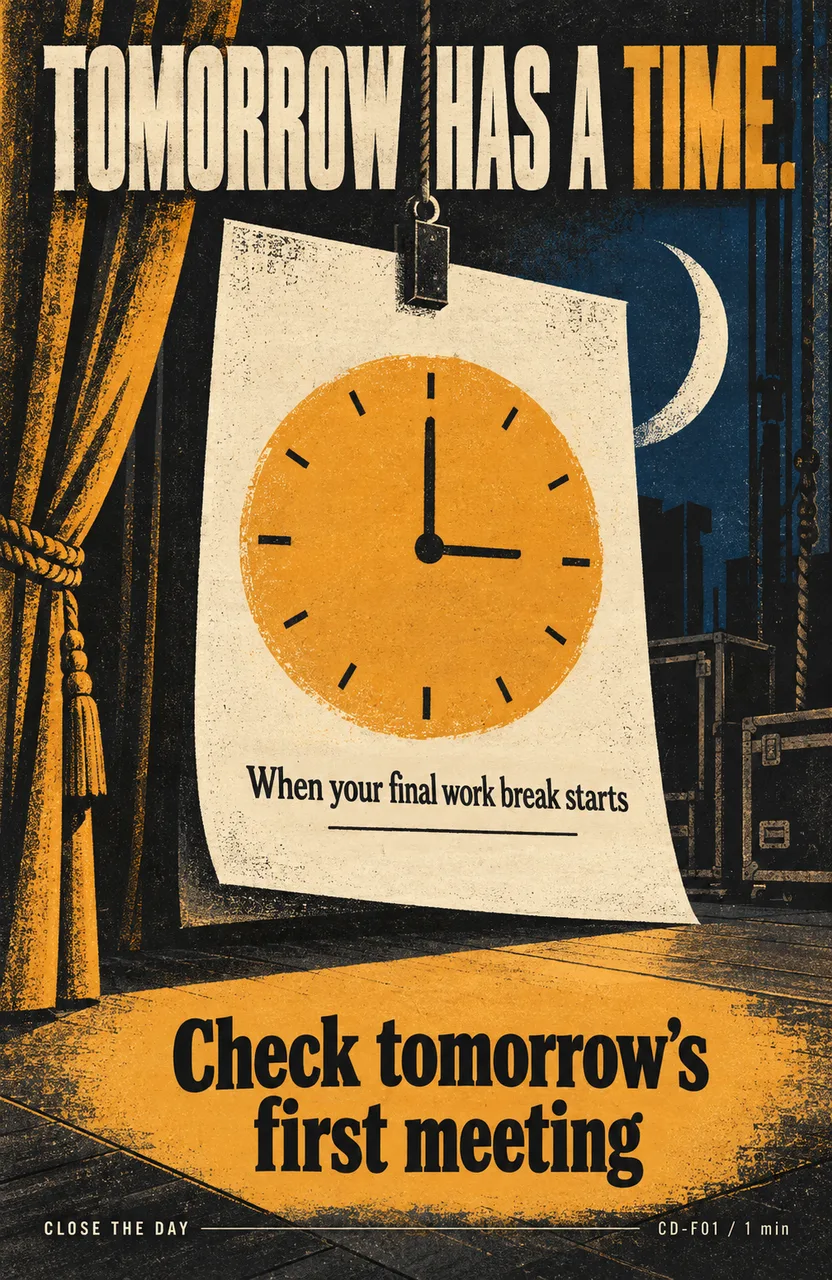
Backstage proofs: rough charcoal and amber screenprints on warm paper, bold condensed lettering, flat cut shapes and visible ink grain. Four small actions.
Growth
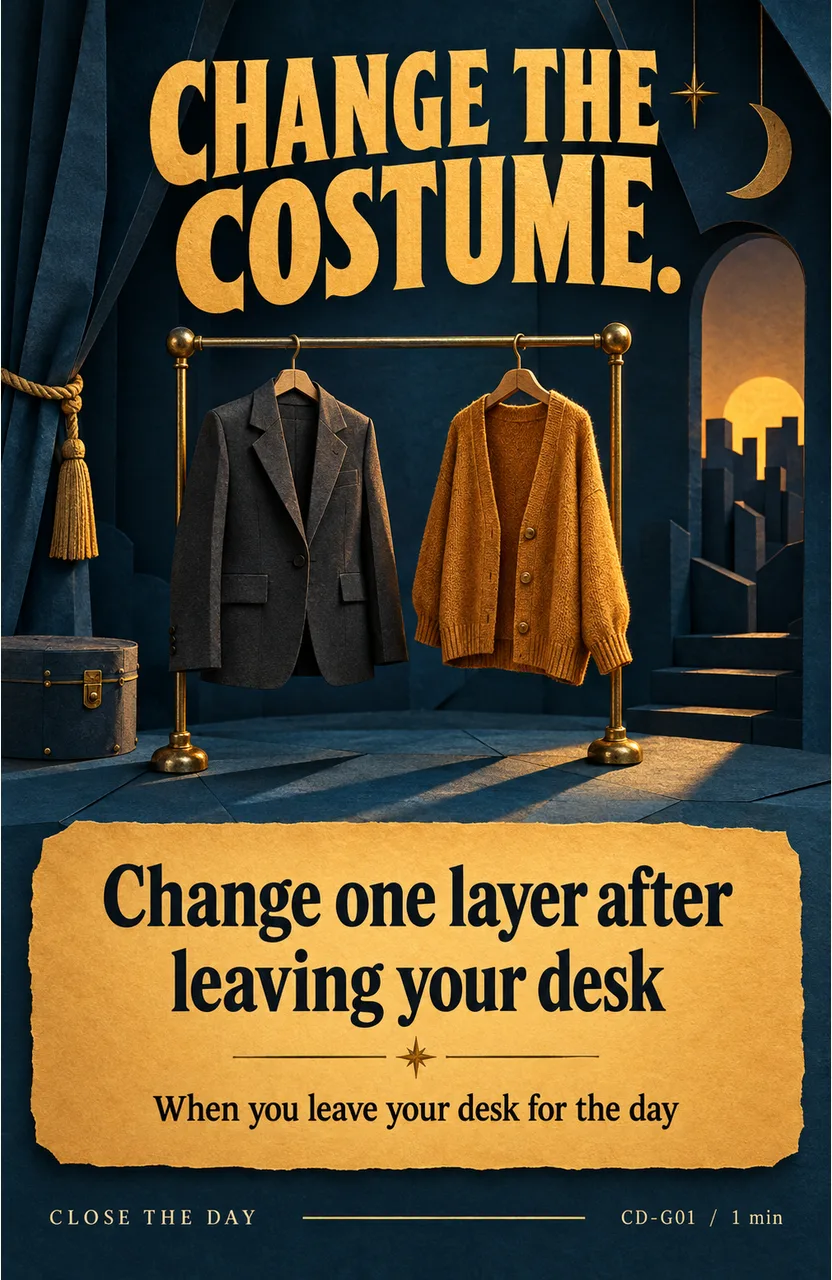
Working stage machinery: dimensional paper sets, petrol-blue shadows, amber fabric and brass fittings. Four habits for physical transitions, incoming alerts, outgoing messages and shared ownership.
Mastery
Finished instruments: midnight blue, ivory and polished brass, precise engraving and spacious architectural compositions. Repeated stopping, calendar negotiation and a chosen evening activity.
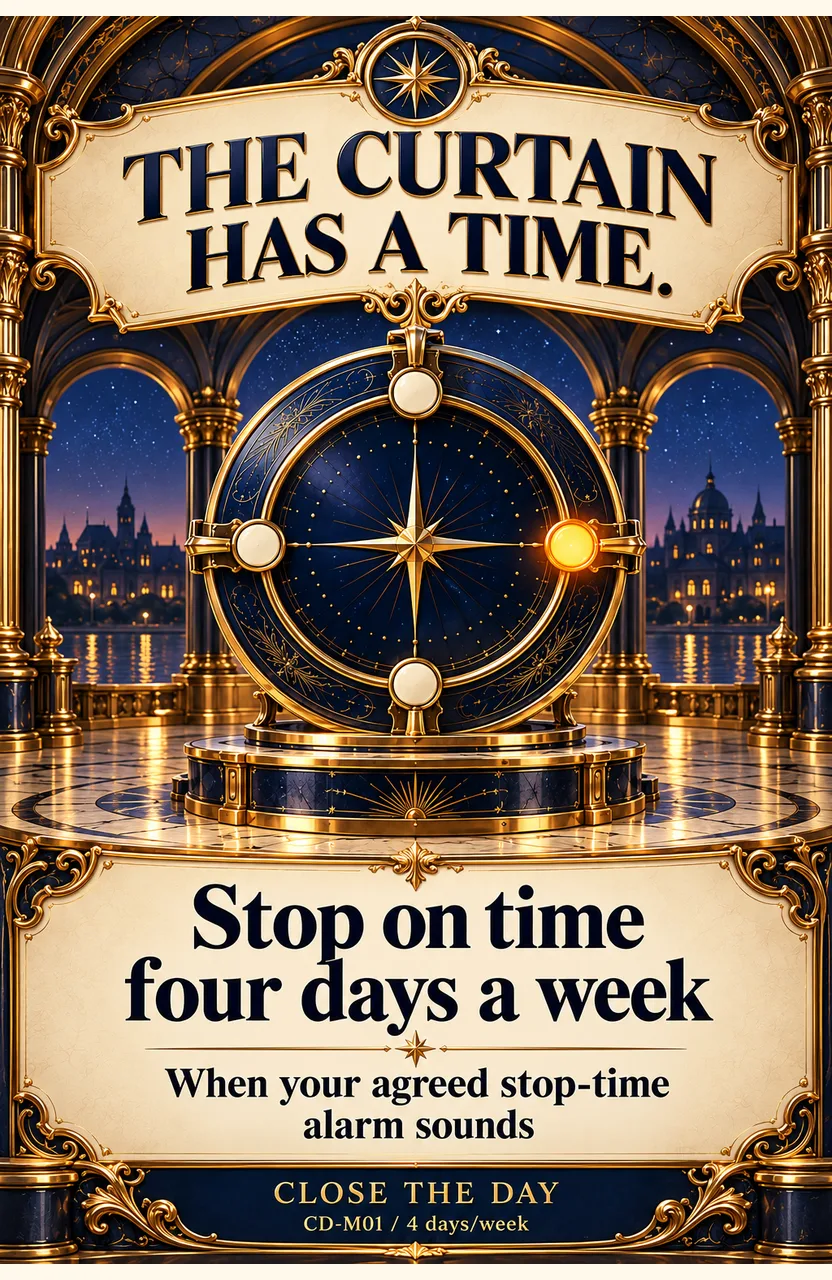
Challenge
After-show inventions: coral, lemon and violet, surreal stage machinery and exuberant integrated lettering. Deliberate experiments in social expectations and signing out.
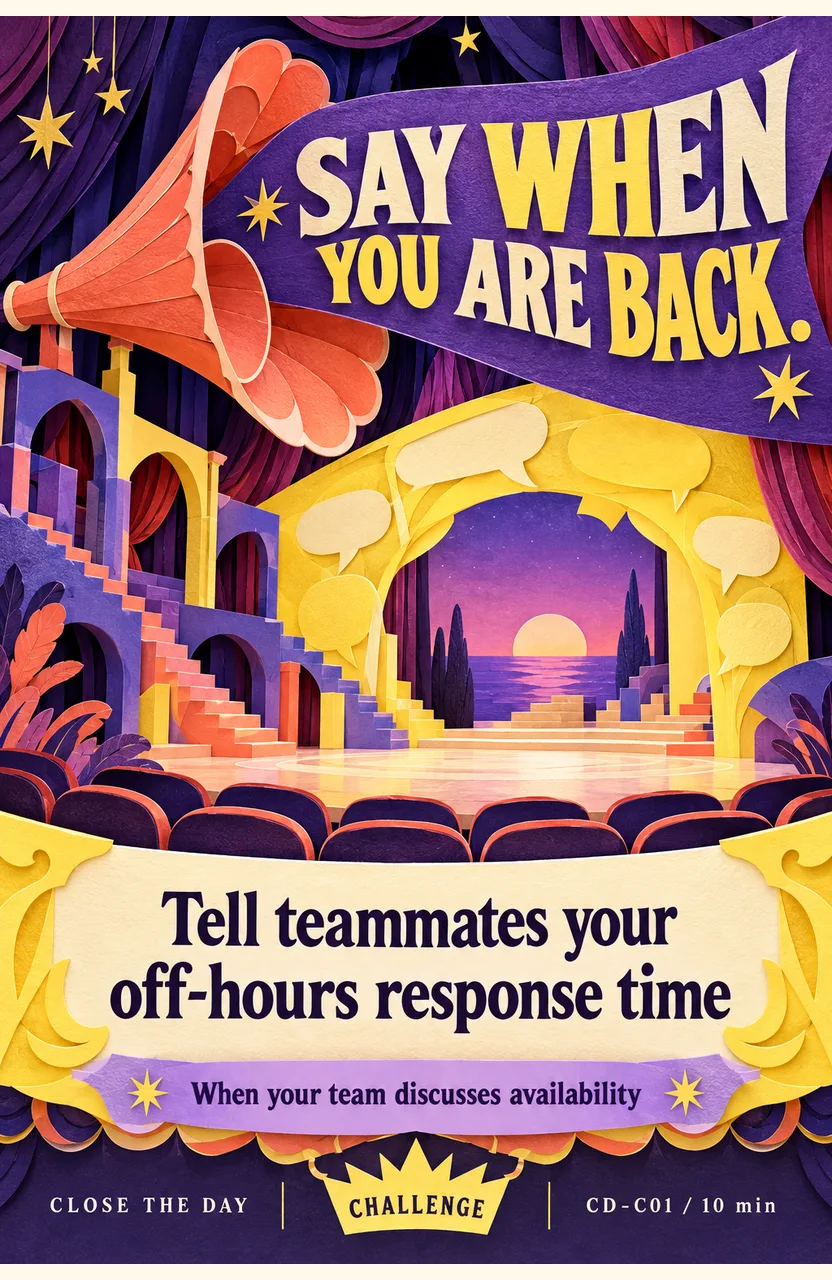
Wry stage-manager headlines; plain instructions and modest claims on the back. Practical experiments are named honestly.
The wall
All 13 cards.
Choose recurring practices that work together, or take on a special mission. Tap any card to flip it.
13 cards · tap a card to flip it
Foundation 4
Small recurring actions with little setup. Choose anchors that fit your day.
Growth 4
Practices that need preparation, a recurring slot or a useful tool.
Mastery 3
Practices you develop over weeks through skill, planning and trade-offs.
Challenge 2
A bounded mission with a clear finish. It can combine practices over days or weeks.
Start with your situation
Ways into this deck.
Find a useful first step, with related cards from across the library.
13 cards · draft
How can I switch off when the workday ends?
Choose where your workday keeps reopening: unfinished tasks, messages, a late meeting or an evening with no activity of your own. Thirteen cards offer small stopping cues and harder boundary practices. A restart plan has direct research support; other exact recipes are practical experiments shaped by your role and team agreements.
12 cards · draft
How can I become a dependable caregiver, including while apart?
Learn your child firsthand, share useful observations and say goodbyes you can stand behind. Agree safe handovers and care boundaries with the adults involved. When you are apart, prepare short familiar contact that fits your child and your real availability. Start with one responsive moment in the care you already provide, then choose a shared-care practice or mission.
10 cards · draft
How do I return to unfinished work?
Find the shape of what exists, identify the working version and check the request before rebuilding from scratch. A draft can stay imperfect while you recover your place.
6 cards · draft
How can I protect an evening that work keeps taking over?
A reliable finish may depend on a handover, a calendar change or a team agreement as much as an individual cue. The harder cards here give those constraints a specific action, while a hobby session gives some personal time a purpose you chose. These are options to test within your role, not promises that a routine can fix understaffing.
2 cards · draft
What can I do when work thoughts keep arriving in the evening?
A plan for unfinished work and a place to catch a later reminder serve different moments. Try a restart plan before leaving, or a short paper note if a thought arrives after work; neither promises to eliminate worry.
4 cards · draft
How can I pause routine work notifications after hours?
Incoming alerts, outgoing messages and other people’s expectations are different parts of an evening boundary. These cards offer a routine alert schedule, delayed non-urgent sending, a team conversation and an optional one-evening sign-out trial. Required coverage and emergency routes still apply.
Get the deck
Free to download. Worth printing.
The same 13 cards either way. Download and print them at home today, or get the printed edition and have them ready to pin up.
Free · digital download
Print it at home
$0
- All 13 cards, front and back
- Print on your own printer or save as a PDF
- Each card's full page online, with its source
- No account, no email
Paid · printed edition
Keep it in print
Price set before launch
- Professionally printed, full-colour fronts and backs
- Cut, stacked and ready to pin up
- QR codes that open each card's page
- Pays for the free library
Printed edition in the works · waitlist open
What's the difference between the free deck and the printed deck?
The cards are the same. The free deck is a download: open it in the print studio and print it at home or save it as a PDF. The printed edition is professionally printed, front and back, with each card's QR code, so it's ready to pin up the day it arrives.
Can I buy a printed deck right now?
Not yet. The original boxed decks are sold out, and the printed editions of the library decks are being prepared. Join the waitlist on any deck and we'll email you once when it's ready to order.
Do I have to do a card every day?
No. You can pin one card and keep at it until it sticks, or draw a card a day for variety. Both work. The point is repeating something worthwhile at a moment you already have.
What if I miss a day?
Pick it up the next time the cue comes round. In the best-known study of habit formation, missing a single day didn't measurably set people back. Every card also says how the habit usually slips and what to do about it.
Are Challenge cards required?
No. They're bounded missions with a clear finish, from one evening to a few weeks. Do one when you want a stretch, and skip any that don't fit your life or health.
From the screen to the fridge
Put the card where the habit happens.
Every deck is free to download and print at home, then pin up: on the fridge, the mirror, beside the monitor. Or get the printed edition, ready to pin up the day it arrives.