DB-F013 minWalk for 3 minutes after calls
Topic deck · 18 cards · prefix DB
Room to Move
Small changes to how you move, look and sit through desk days.
You spend long days at a screen, leaning in and barely moving between calls, and you'd like a few practical changes rather than a posture overhaul.
- Foundation 8
- Growth 5
- Mastery 3
- Challenge 2
11 sources citedCard evidence: 5 A · 1 B · 12 C. Grades describe evidence, not deck quality.
Is this deck for you?
Where it takes you.
Specific movement, screen and setup habits for desk days. Practical experiments are clearly distinguished from evidence-backed guidance; no posture fixes or pain cures.
From
Stuck in one position at the screen all day
To
Moving between tasks, resting my eyes and using a desk setup that fits
What the cards have you do
- Walk for three minutes after calls and change sitting position after each file, so movement attaches to the work itself.
- Look far away for twenty seconds, and increase text size instead of leaning toward the screen.
- Move your active window straight ahead and your mouse beside the keyboard: setup changes you make once.
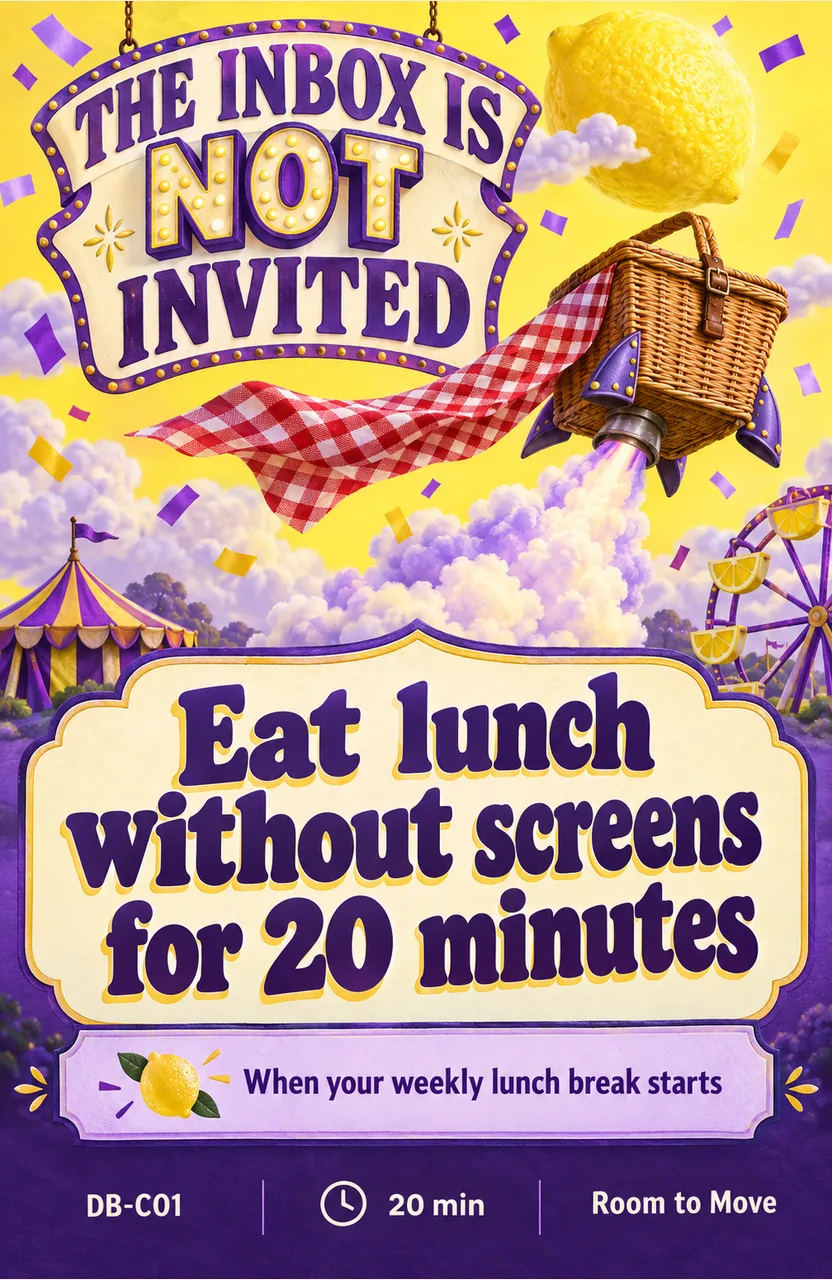
- Eat lunch without screens for twenty minutes, or walk through one ten-minute audio meeting each week.
The world of this deck
Four ways to use this deck.
A small workshop for making room: bold objects escape fixed positions. Cream, ink and vermilion become teal paper models, then cobalt and brass kinetic sculptures, then lemon-violet carnival inventions. No anatomical demonstrations or repair metaphors.
Foundation
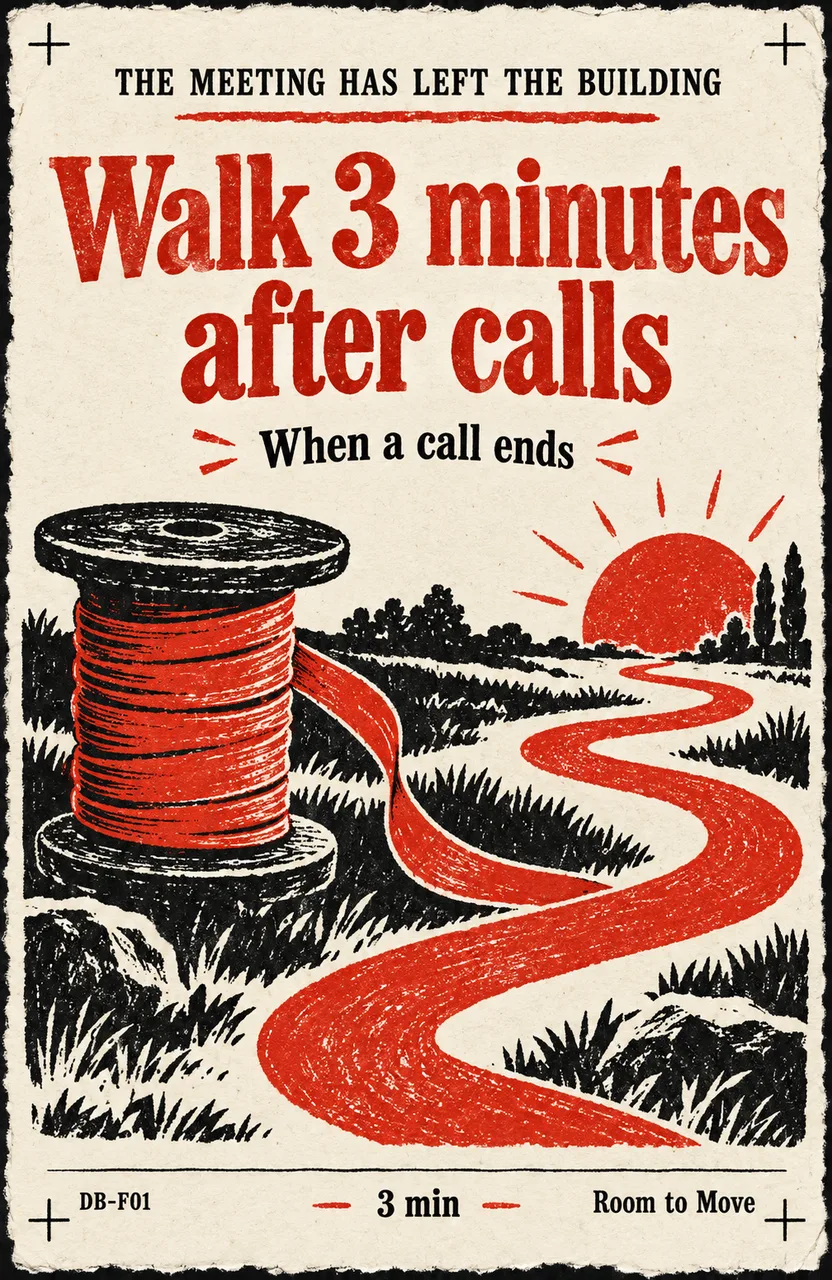
Rough two-colour linocut and torn paper, broad ink lettering, exposed registration marks; no uniform border.
Growth
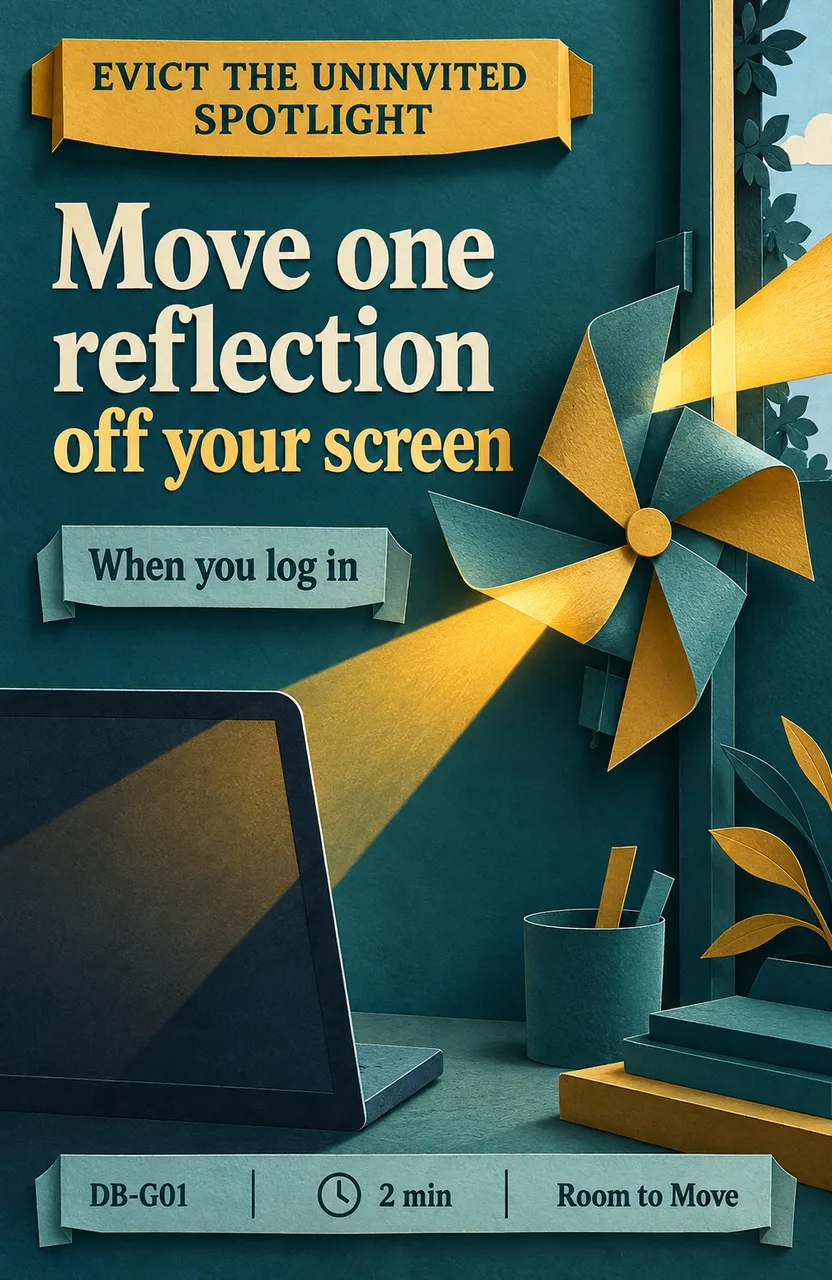
Dimensional cut-paper workshop models, teal and ochre, folded text planes, visible tabs and shadows.
Mastery
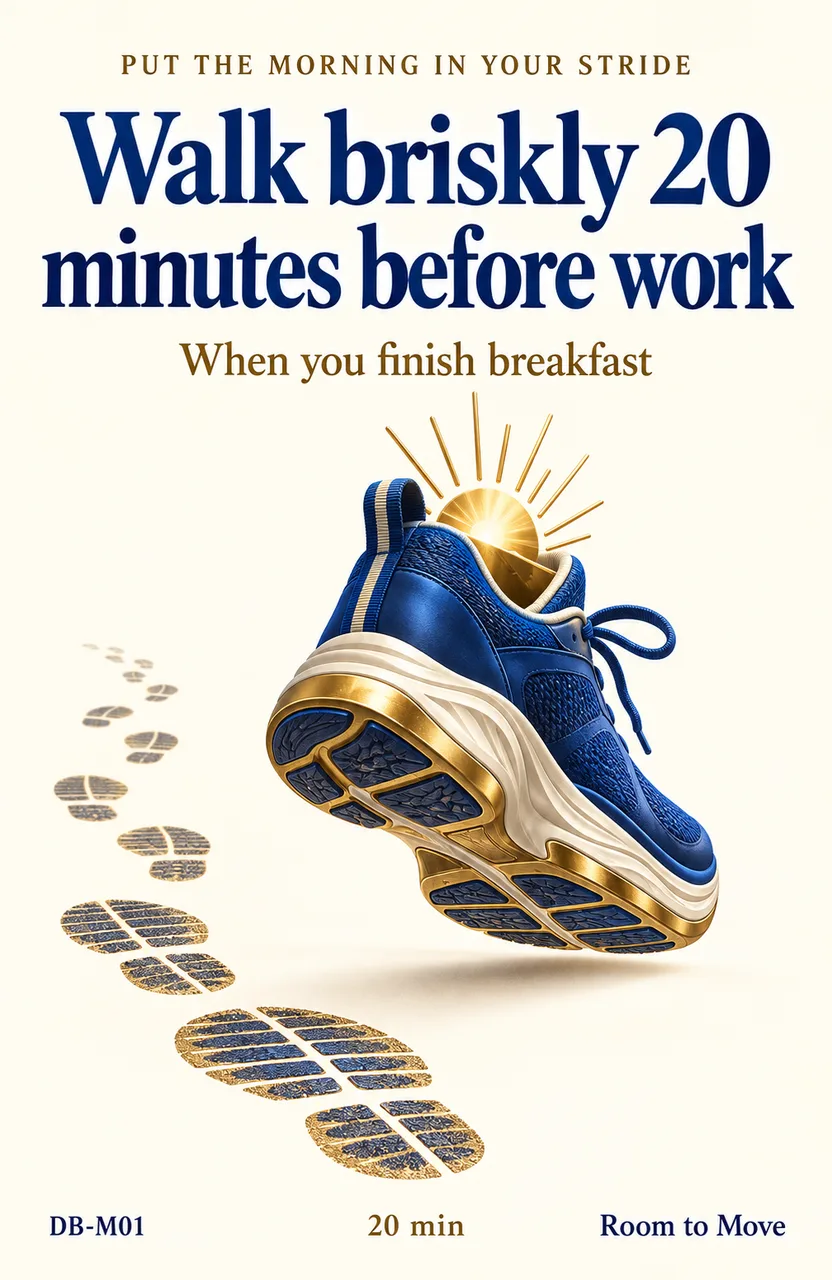
Finished cobalt enamel and brass kinetic sculpture, spacious typography engraved on broad planes, polished edges.
Challenge
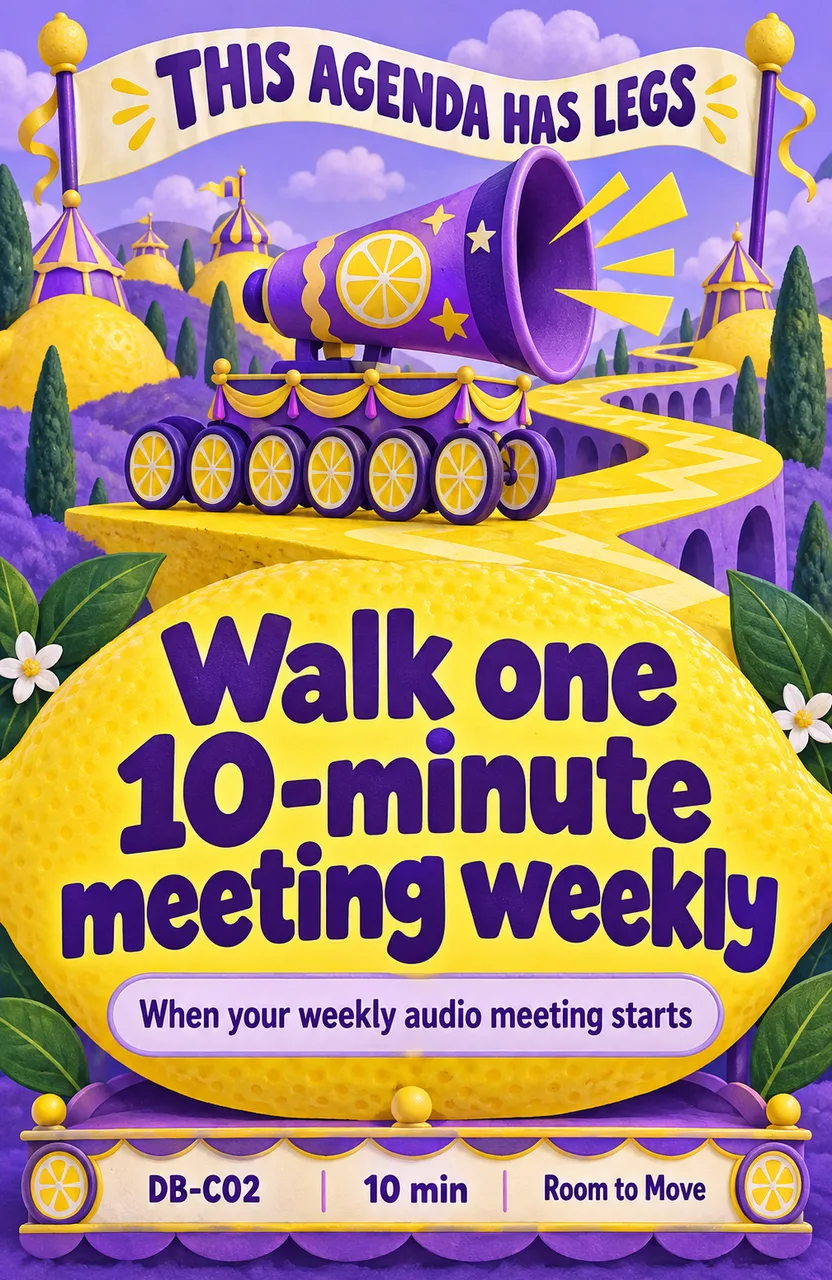
Lemon and violet surreal carnival inventions, elastic composition and oversized playful lettering.
Dry workshop wit in headlines; literal instructions and modest claims in the content.
The wall
All 18 cards.
Choose recurring practices that work together, or take on a special mission. Tap any card to flip it.
18 cards · tap a card to flip it
Foundation 8
Small recurring actions with little setup. Choose anchors that fit your day.
DB-F0220 secIncrease text size before leaning forward
DB-F0320 secMove your active window straight ahead
DB-F0430 secPlace your mouse beside the keyboard
DB-F0520 secLook far away for 20 seconds
DB-F0615 secBlink slowly five times after sending
DB-F0720 secChange sitting position after each file
DB-F0830 secSupport both feet before typing
Growth 5
Practices that need preparation, a recurring slot or a useful tool.
DB-G012 minMove one reflection off your screen
DB-G021 minTurn your head three times each way
DB-G031 minLift each knee five times while seated
DB-G045 minDo a screen-free task for 5 minutes
DB-G0530 secAim the desk fan away from your face
Mastery 3
Practices you develop over weeks through skill, planning and trade-offs.
DB-M0120 minWalk briskly for 20 minutes before work
DB-M028–12 minPractise a strength circuit twice weekly
DB-M032 minRecord headaches nightly for eight weeks
Challenge 2
A bounded mission with a clear finish. It can combine practices over days or weeks.
DB-C0120 minEat lunch without screens for 20 minutes
DB-C0210 minWalk through one 10-minute meeting weekly
Start with your situation
Ways into this deck.
Find a useful first step, with related cards from across the library.
9 cards · draft
How can I build stamina without a gym?
Begin with GF-F09 marching at a midday break, or choose GF-G08 brisk walking or GF-G12 dancing. GF-M07 supplies two repeatable steady-cardio appointments; add time gradually from a comfortable start. GF-C07 helps you try activities and keep one you enjoy, while GF-C08 gives your movement a local destination. Short breaks help you move during desk days; a two-minute break alone is not a complete conditioning program. Pair aerobic practice with two strength days. Related DB walking cards remain available as alternatives.
10 cards · draft
How can I practise overhead reach and controlled turning?
After warming up, try three shoulder-blade circles each way, three upper-back turns per side and three lying arm raises. About six minutes, twice weekly. These rehearse shoulder-blade movement, trunk turning and active arm returns. Add a supported bench reach if useful, or use FL-M05 to combine overhead practice without double sets. This is a practice invitation, not a promised result.
8 cards · draft
What can I try for tired eyes during screen work?
Try readable text, fewer reflections and pauses away from the screen. The exact eye-break dose remains uncertain, and persistent discomfort or blurred vision needs an eye examination.
3 cards · draft
What should I track if I keep getting headaches at my desk?
A headache diary can support a conversation with a clinician without assuming the screen is the cause. Repeated or severe headaches need assessment; sudden extremely painful headache or new neurological symptoms needs emergency care.
24 cards · draft
How can I get fit around a work-from-home desk job?
Use GF-M05 for one supplied strength round on Monday and Thursday. Walk GF-G08 on Tuesday, Wednesday and Friday; start with 5–10 minutes, or use GF-F09 marching indoors. Learn chair stands, push-ups and rows from GF-F07, GF-F08 and GF-G07. Scale the version on each back. The tiny start keeps participation; it is not the full training dose. GF-C05 packages the first week. Pick optional additions later, rather than doing all twenty cards every day. Build gradually toward adult activity guidance.
7 cards · draft
What can I try when my lower back feels stiff after sitting?
Start with comfortable movement and a setup you can vary. These habits do not identify the cause of back pain; persistent or worsening symptoms deserve assessment.
4 cards · draft
What can I change when laptop work leaves my neck uncomfortable?
Try moving the task and its controls closer to where you comfortably look and reach. Gentle movement is an option, but these cards are not a neck-pain treatment programme.
5 cards · draft
Do I have to stand all day instead of sitting?
A standing desk can reduce sitting time, but that is not proof of pain relief. Try manageable movement and comfortable position changes instead of an all-day standing target.
7 cards · draft
What can I do when my hips feel stiff after sitting?
Use a comfortable movement option and let your sitting position vary. A tight feeling does not establish a diagnosis; worsening pain is a reason to stop and seek advice.
6 cards · draft
How can I fit movement into a desk day when I feel drained?
A brief transition can be a place to start, while a regular walk or strength session takes more planning. Small average fatigue benefits from breaks do not mean every tired feeling is caused by sitting.
16 cards · draft
How do I make home strength progress visible?
First do useful strength work. Start with GF-F07 chair stands, GF-F08 push-ups and GF-F12 bridges, then use the ready GF-M05 round on two nonconsecutive days. GF-G07 adds a pull; optional hinge, carry, step-up and core cards broaden the practice. When one movement is consistently manageable, GF-M06 gives a small progression. GF-M08 records one actual set. GF-C06 compares the same comfortable sets after four weeks, without a maximum test or guaranteed result. The starter round is an entry, not an exhaustive exercise program.
Get the deck
Free to download. Worth printing.
The same 18 cards either way. Download and print them at home today, or get the printed edition and have them ready to pin up.
Free · digital download
Print it at home
$0
- All 18 cards, front and back
- Print on your own printer or save as a PDF
- Each card's full page online, with its source
- No account, no email
Paid · printed edition
Keep it in print
Price set before launch
- Professionally printed, full-colour fronts and backs
- Cut, stacked and ready to pin up
- QR codes that open each card's page
- Pays for the free library
Printed edition in the works · waitlist open
What's the difference between the free deck and the printed deck?
The cards are the same. The free deck is a download: open it in the print studio and print it at home or save it as a PDF. The printed edition is professionally printed, front and back, with each card's QR code, so it's ready to pin up the day it arrives.
Can I buy a printed deck right now?
Not yet. The original boxed decks are sold out, and the printed editions of the library decks are being prepared. Join the waitlist on any deck and we'll email you once when it's ready to order.
Do I have to do a card every day?
No. You can pin one card and keep at it until it sticks, or draw a card a day for variety. Both work. The point is repeating something worthwhile at a moment you already have.
What if I miss a day?
Pick it up the next time the cue comes round. In the best-known study of habit formation, missing a single day didn't measurably set people back. Every card also says how the habit usually slips and what to do about it.
Are Challenge cards required?
No. They're bounded missions with a clear finish, from one evening to a few weeks. Do one when you want a stretch, and skip any that don't fit your life or health.
From the screen to the fridge
Put the card where the habit happens.
Every deck is free to download and print at home, then pin up: on the fridge, the mirror, beside the monitor. Or get the printed edition, ready to pin up the day it arrives.