Become a Dad They Can Count On · the new backs

Turn it over.
Everything you need to start.

Each back carries the cue, the action, the support you need and a tiny first step, at a size you can read on the fridge.

24 backs, made for the hand.
Designed at Postcard size, 100 × 154 mm. The reading pages keep the extra explanation and full citations.

Print the deck →

Tap a card to compare its front and new back. The comparison prints at 100 × 154mm; use 100% scale and check the 50mm line.

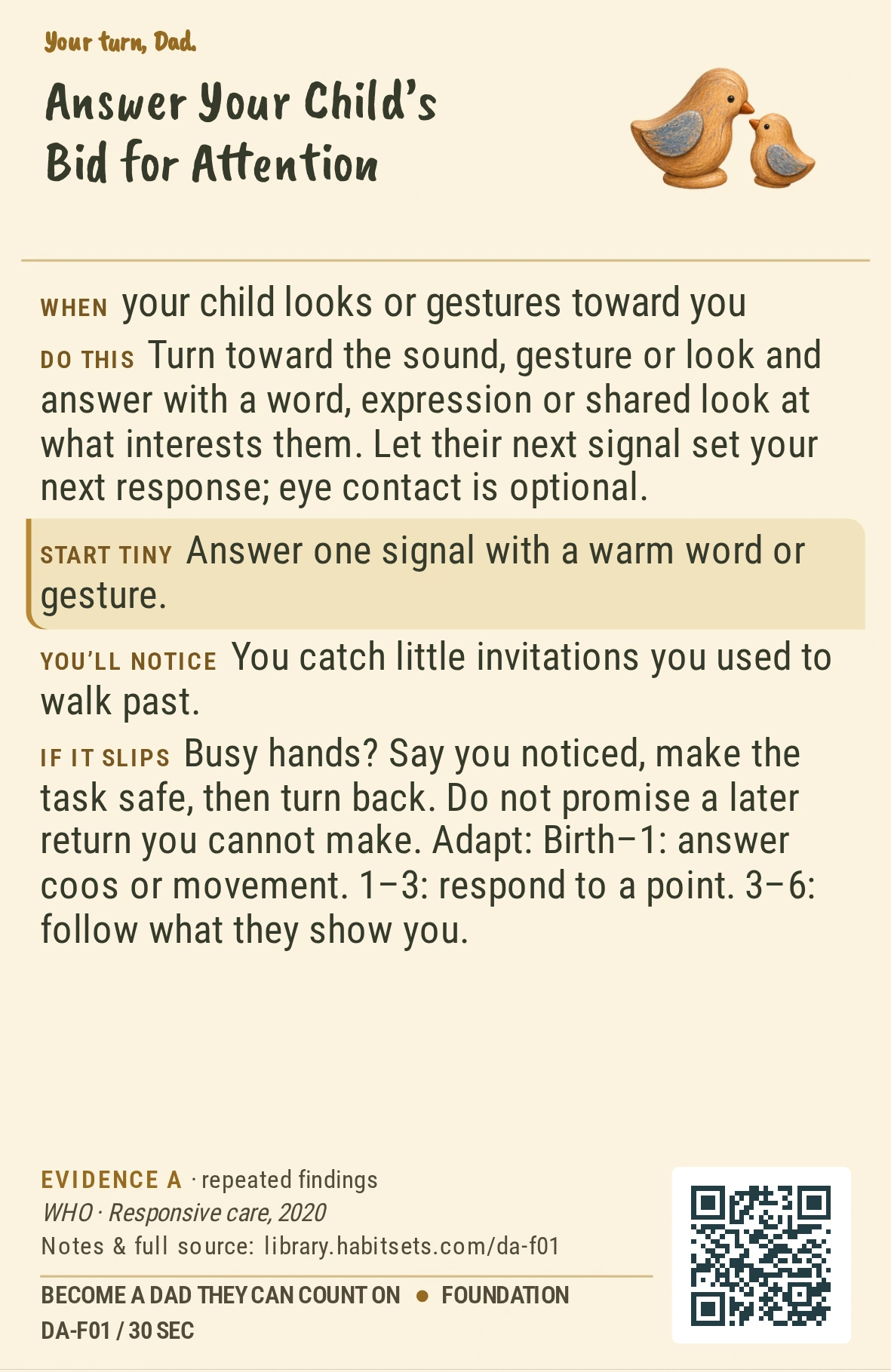
Front of DA-F01Back of card DA-F01: Answer Your Child’s Bid for Attention. When: your child looks or gestures toward you Do this: Turn toward the sound, gesture or look and answer with a word, expression or shared look at what interests them. Let their next signal set your next response; eye contact is optional. Start tiny: Answer one signal with a warm word or gesture.
50mm · DA-F01 · actual size
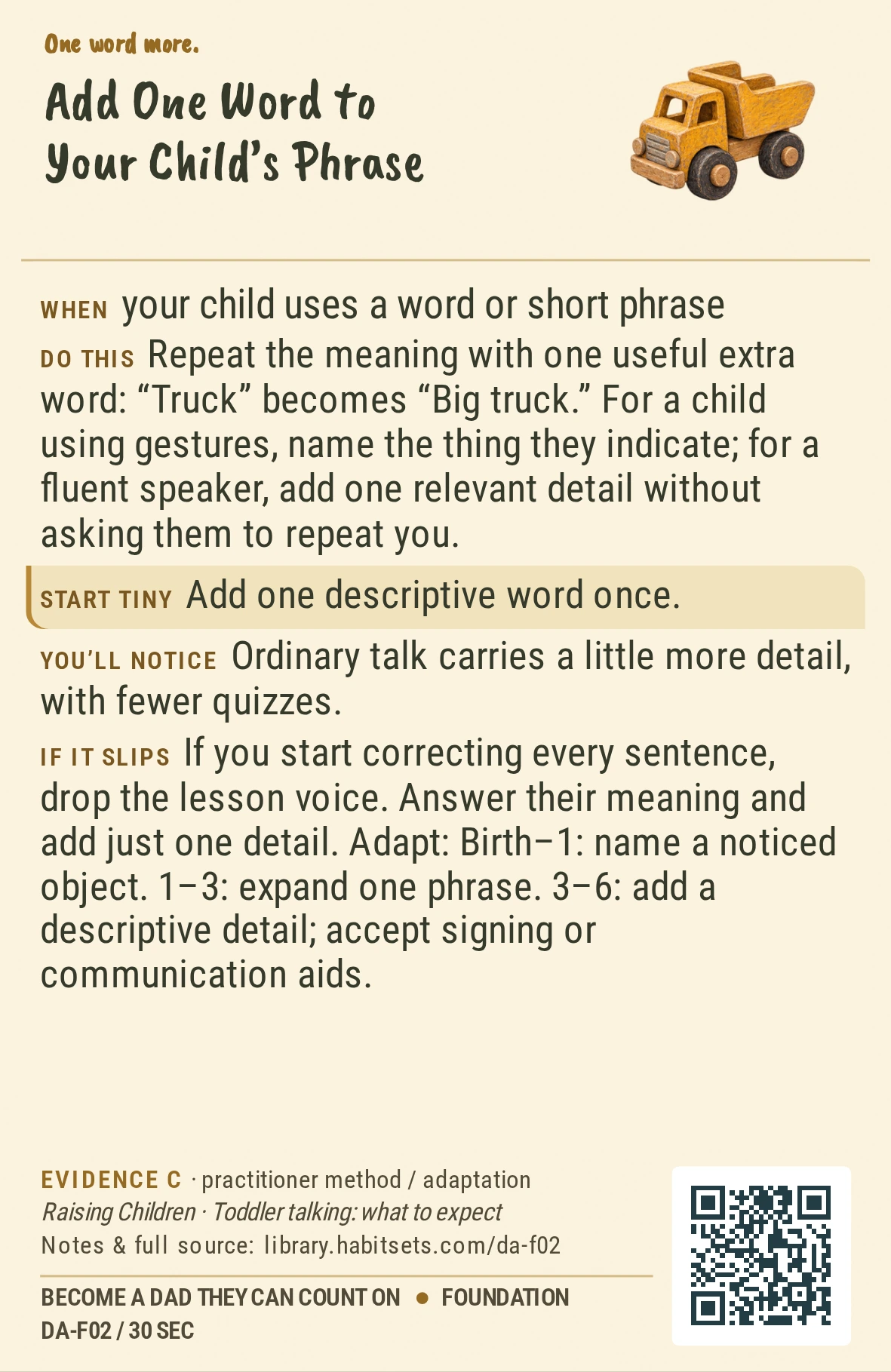
Front of DA-F02Back of card DA-F02: Add One Word to Your Child’s Phrase. When: your child uses a word or short phrase Do this: Repeat the meaning with one useful extra word: “Truck” becomes “Big truck.” For a child using gestures, name the thing they indicate; for a fluent speaker, add one relevant detail without asking them to repeat you. Start tiny: Add one descriptive word once.
50mm · DA-F02 · actual size
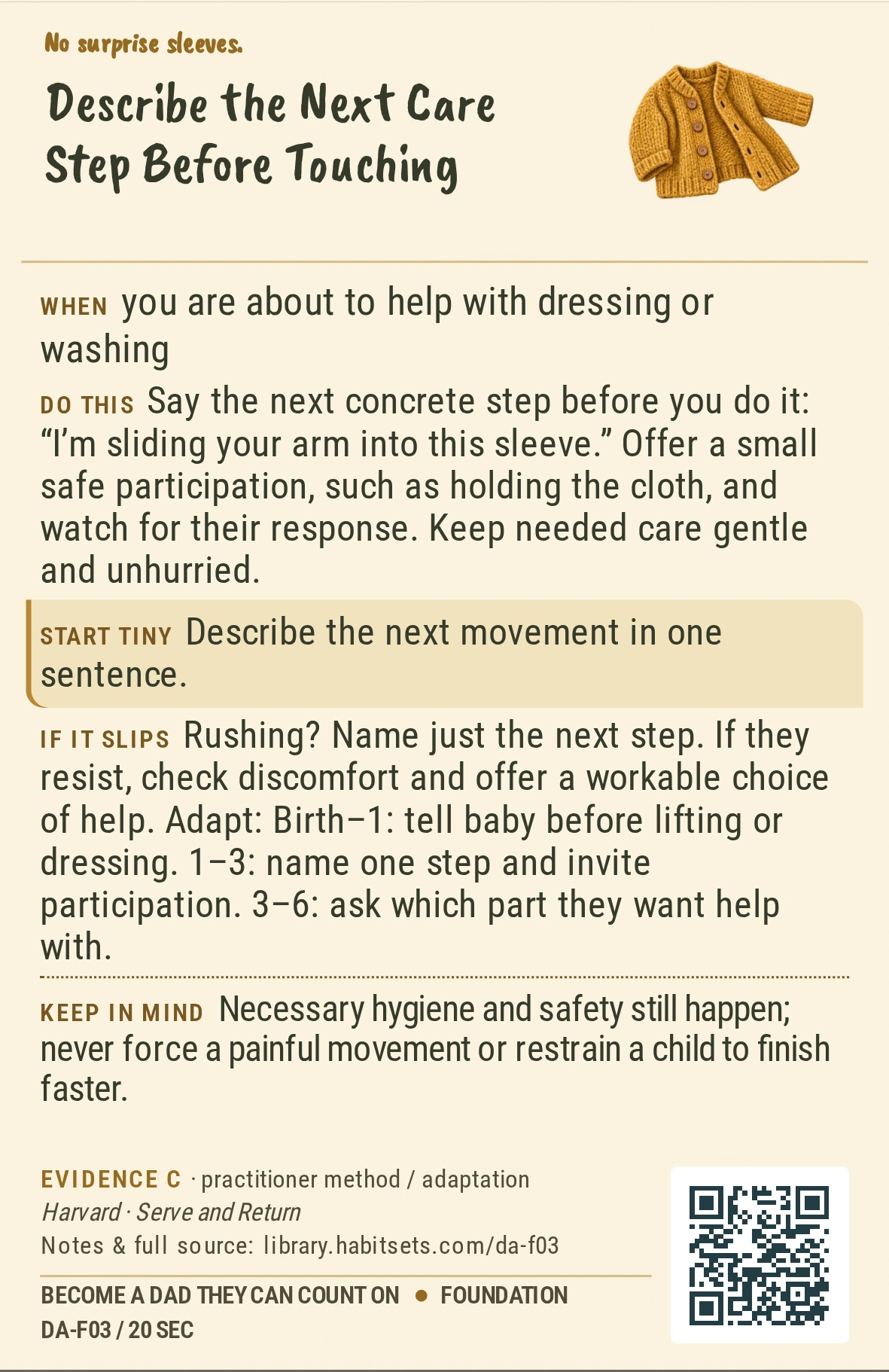
Front of DA-F03Back of card DA-F03: Describe the Next Care Step Before Touching. When: you are about to help with dressing or washing Do this: Say the next concrete step before you do it: “I’m sliding your arm into this sleeve.” Offer a small safe participation, such as holding the cloth, and watch for their response. Keep needed care gentle and unhurried. Start tiny: Describe the next movement in one sentence. Keep in mind: Necessary hygiene and safety still happen; never force a painful movement or restrain a child to finish faster.
50mm · DA-F03 · actual size
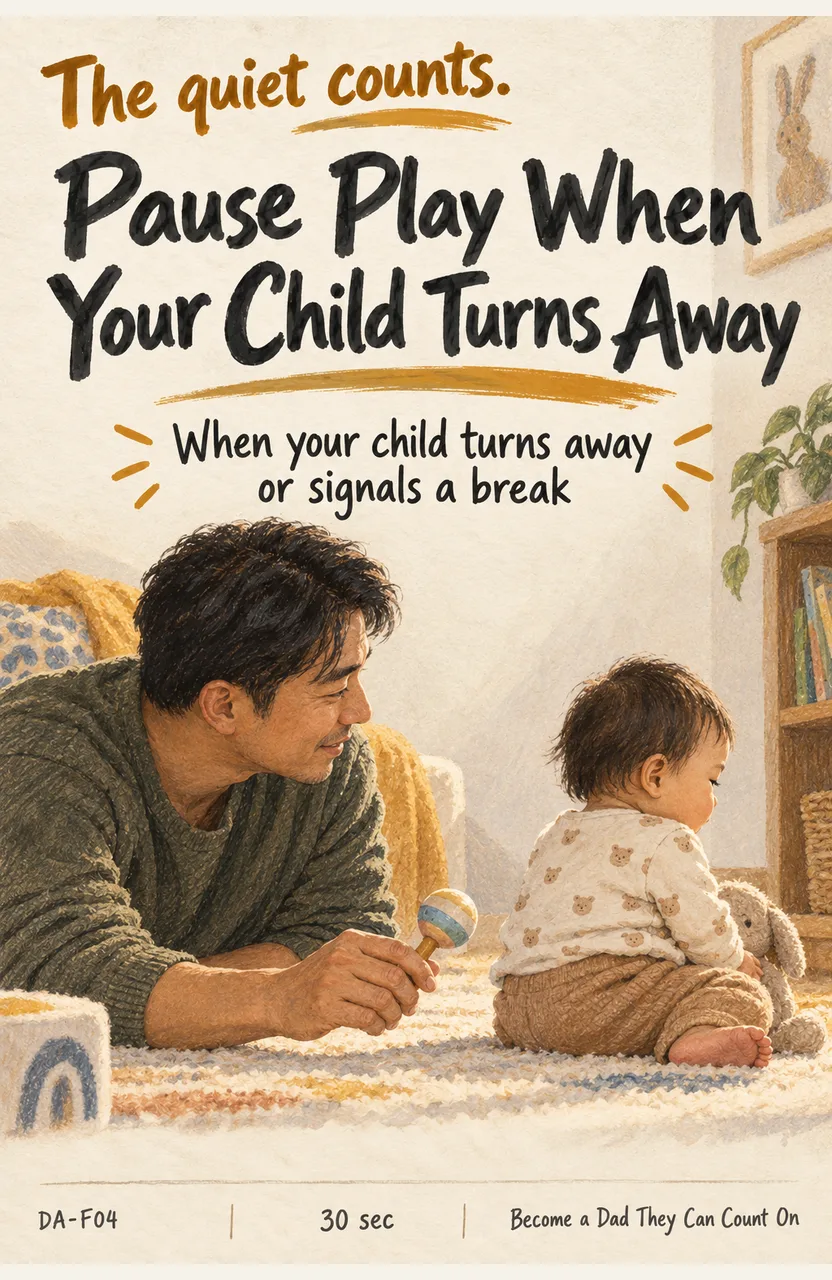
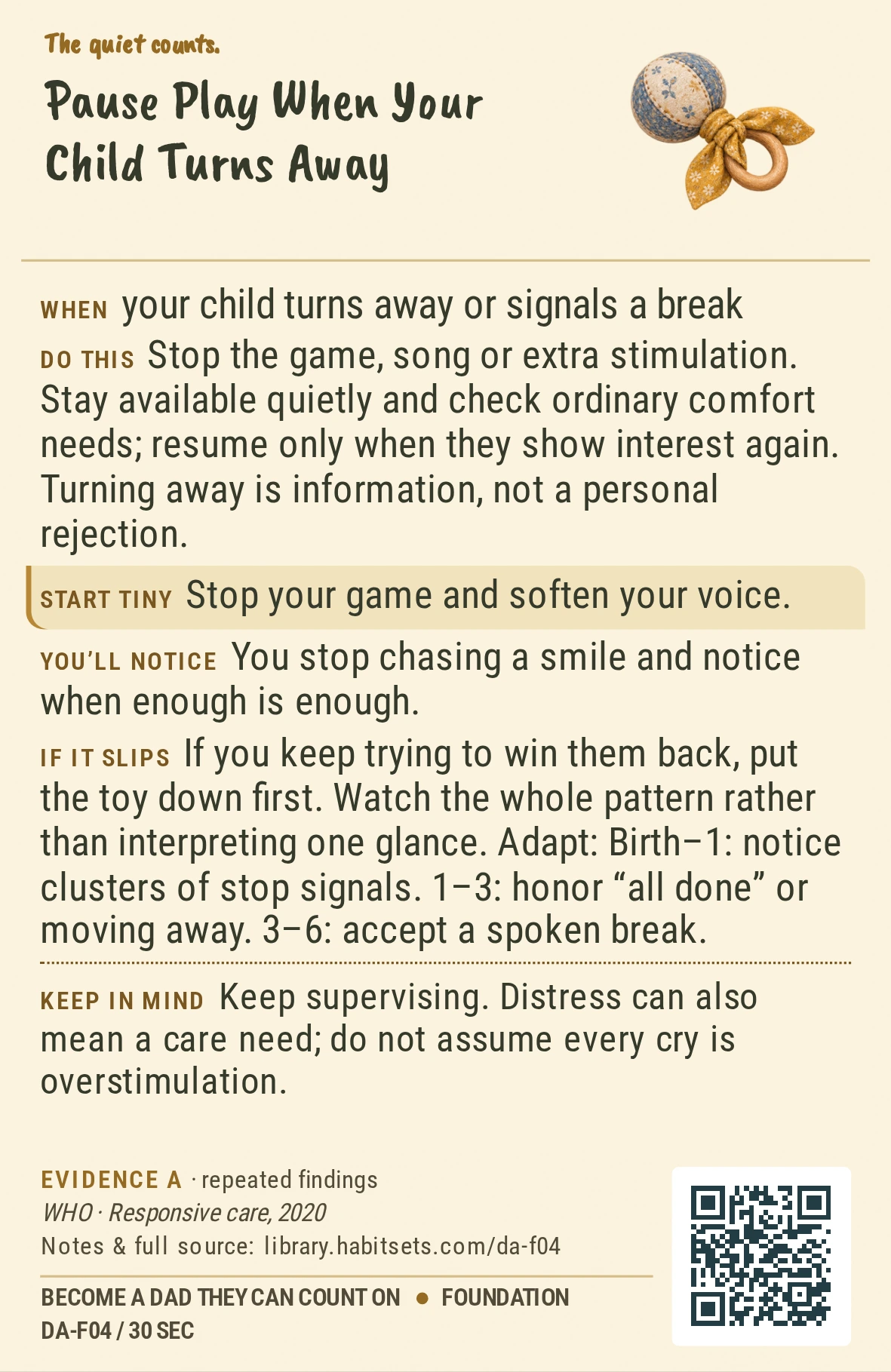
Front of DA-F04Back of card DA-F04: Pause Play When Your Child Turns Away. When: your child turns away or signals a break Do this: Stop the game, song or extra stimulation. Stay available quietly and check ordinary comfort needs; resume only when they show interest again. Turning away is information, not a personal rejection. Start tiny: Stop your game and soften your voice. Keep in mind: Keep supervising. Distress can also mean a care need; do not assume every cry is overstimulation.
50mm · DA-F04 · actual size
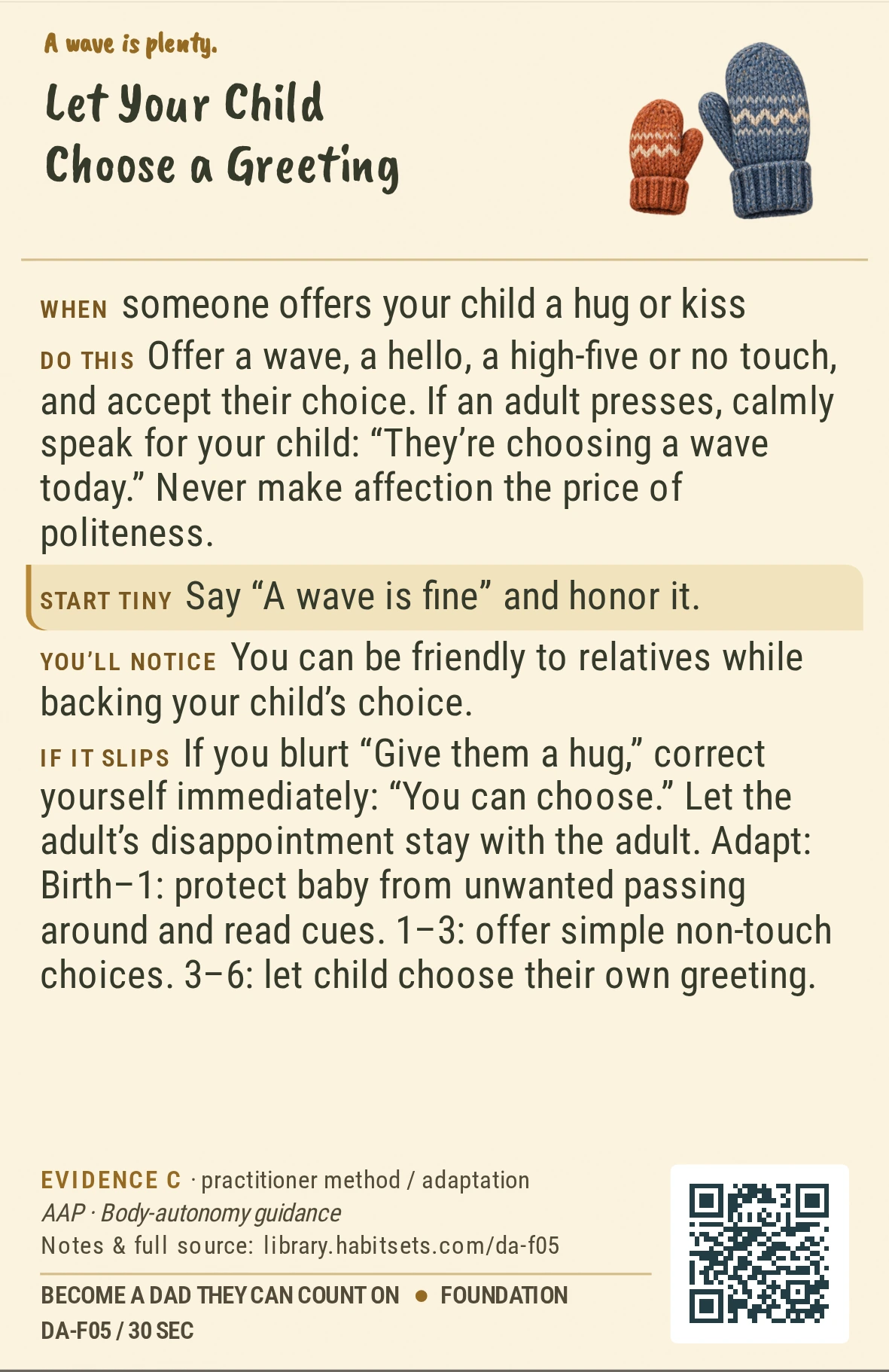
Front of DA-F05Back of card DA-F05: Let Your Child Choose a Greeting. When: someone offers your child a hug or kiss Do this: Offer a wave, a hello, a high-five or no touch, and accept their choice. If an adult presses, calmly speak for your child: “They’re choosing a wave today.” Never make affection the price of politeness. Start tiny: Say “A wave is fine” and honor it.
50mm · DA-F05 · actual size
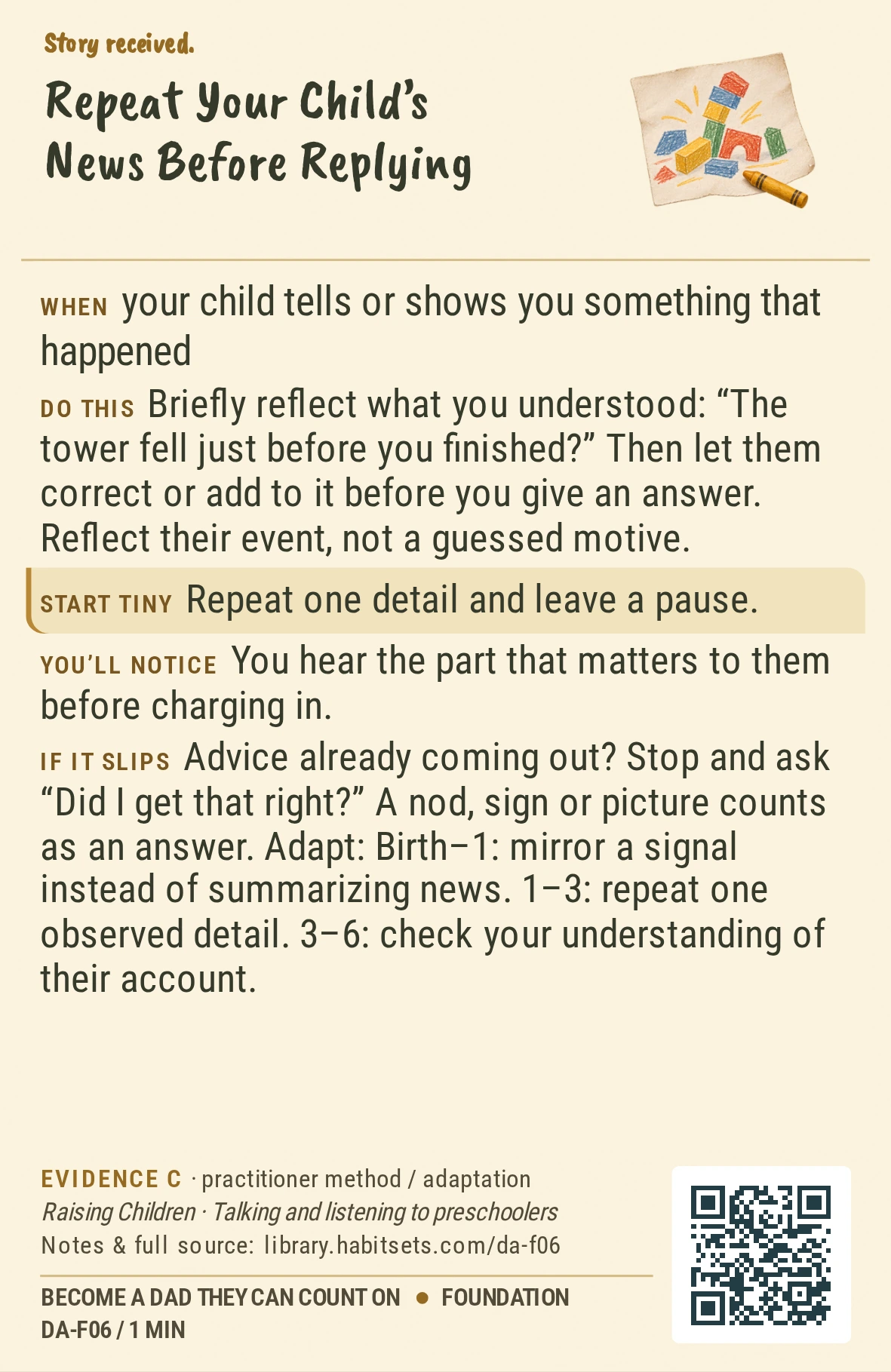
Front of DA-F06Back of card DA-F06: Repeat Your Child’s News Before Replying. When: your child tells or shows you something that happened Do this: Briefly reflect what you understood: “The tower fell just before you finished?” Then let them correct or add to it before you give an answer. Reflect their event, not a guessed motive. Start tiny: Repeat one detail and leave a pause.
50mm · DA-F06 · actual size
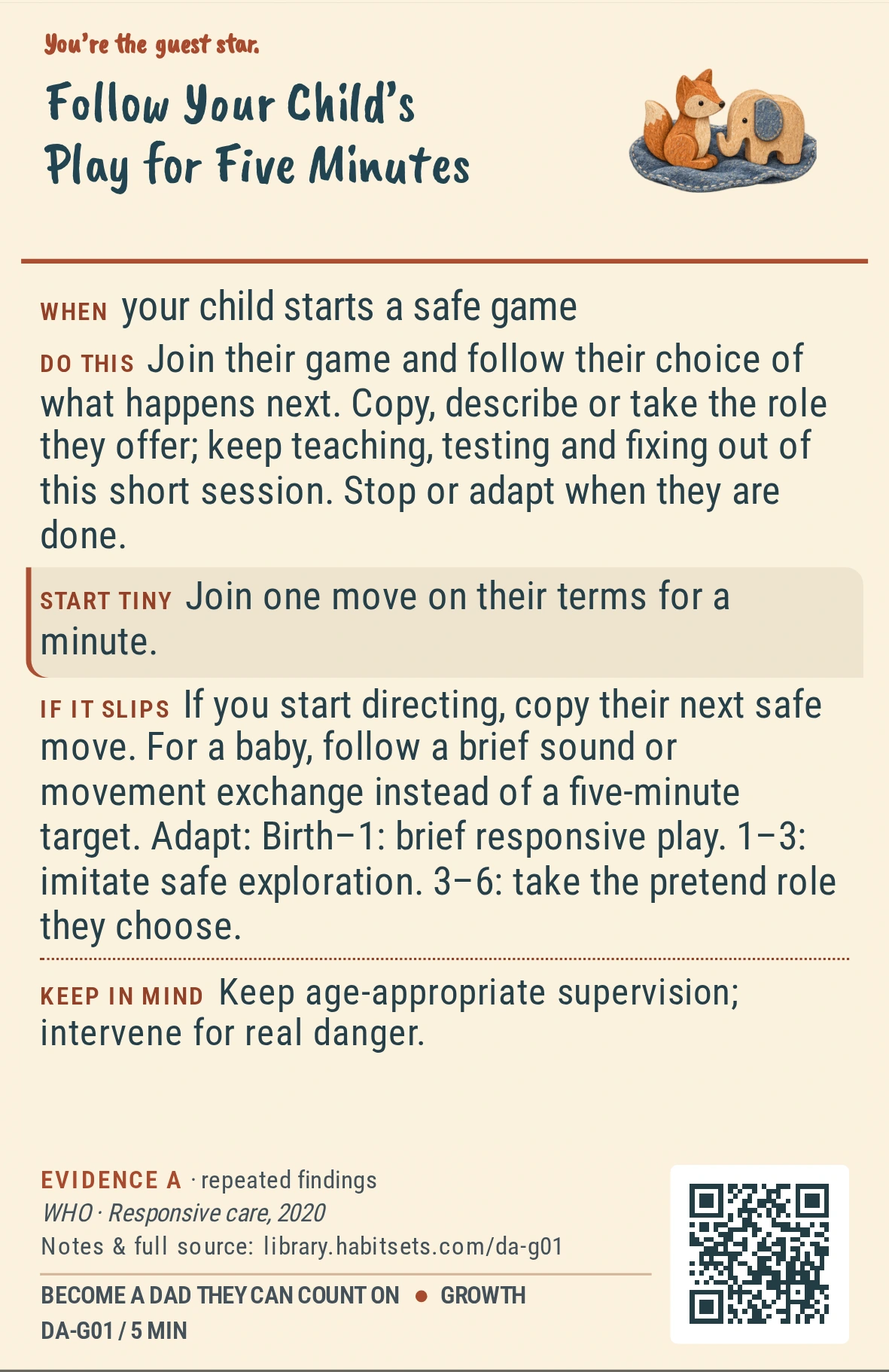
Front of DA-G01Back of card DA-G01: Follow Your Child’s Play for Five Minutes. When: your child starts a safe game Do this: Join their game and follow their choice of what happens next. Copy, describe or take the role they offer; keep teaching, testing and fixing out of this short session. Stop or adapt when they are done. Start tiny: Join one move on their terms for a minute. Keep in mind: Keep age-appropriate supervision; intervene for real danger.
50mm · DA-G01 · actual size
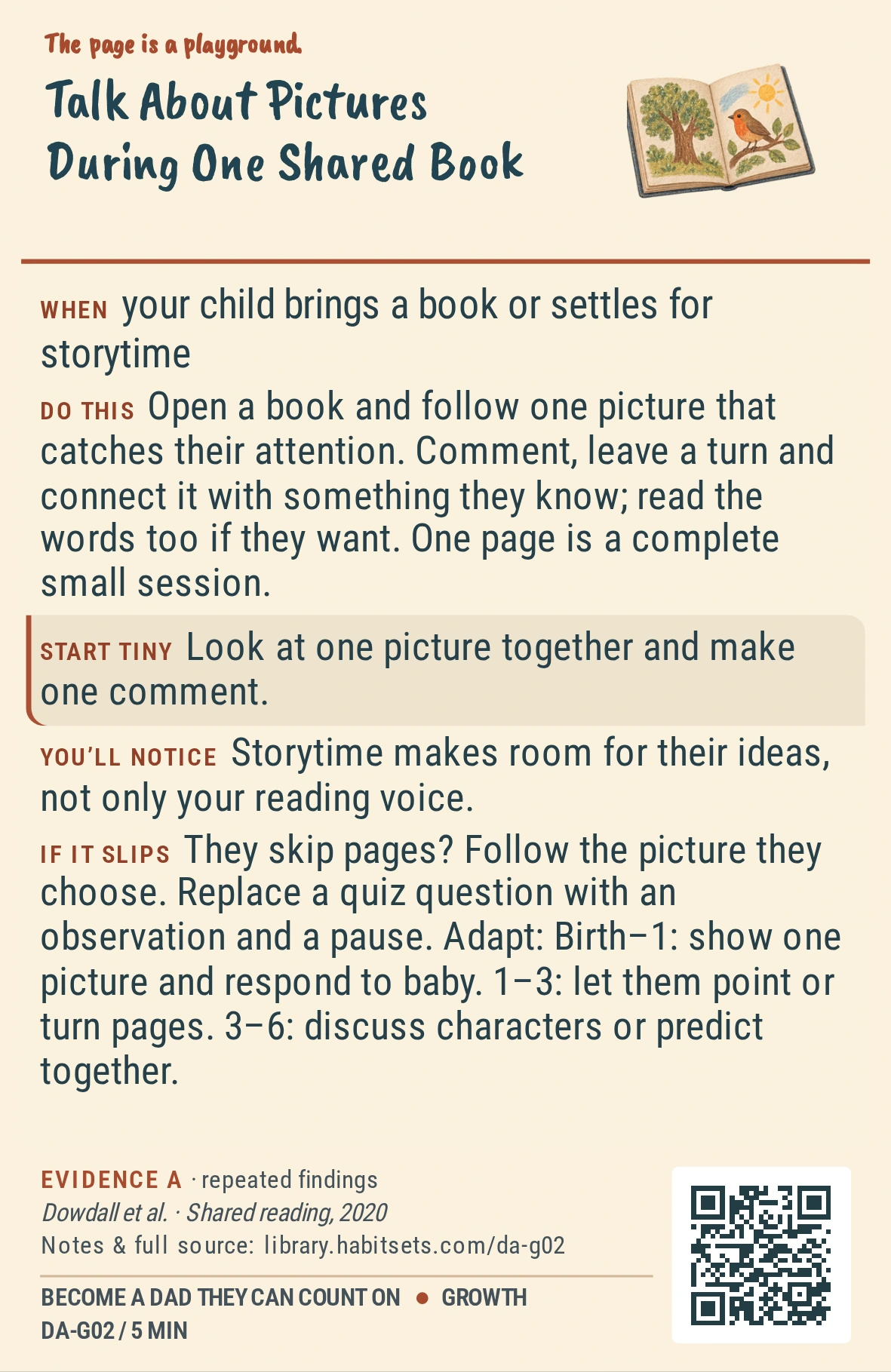
Front of DA-G02Back of card DA-G02: Talk About Pictures During One Shared Book. When: your child brings a book or settles for storytime Do this: Open a book and follow one picture that catches their attention. Comment, leave a turn and connect it with something they know; read the words too if they want. One page is a complete small session. Start tiny: Look at one picture together and make one comment.
50mm · DA-G02 · actual size
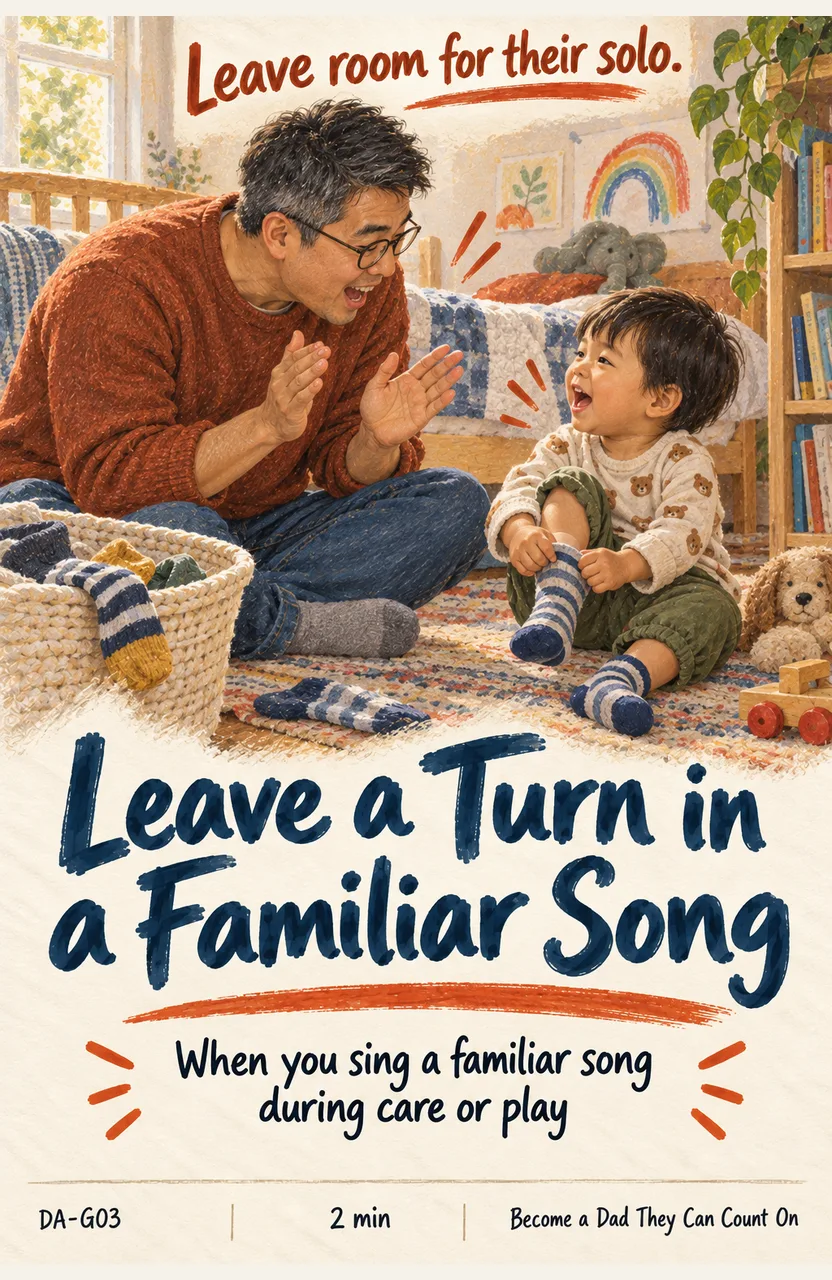
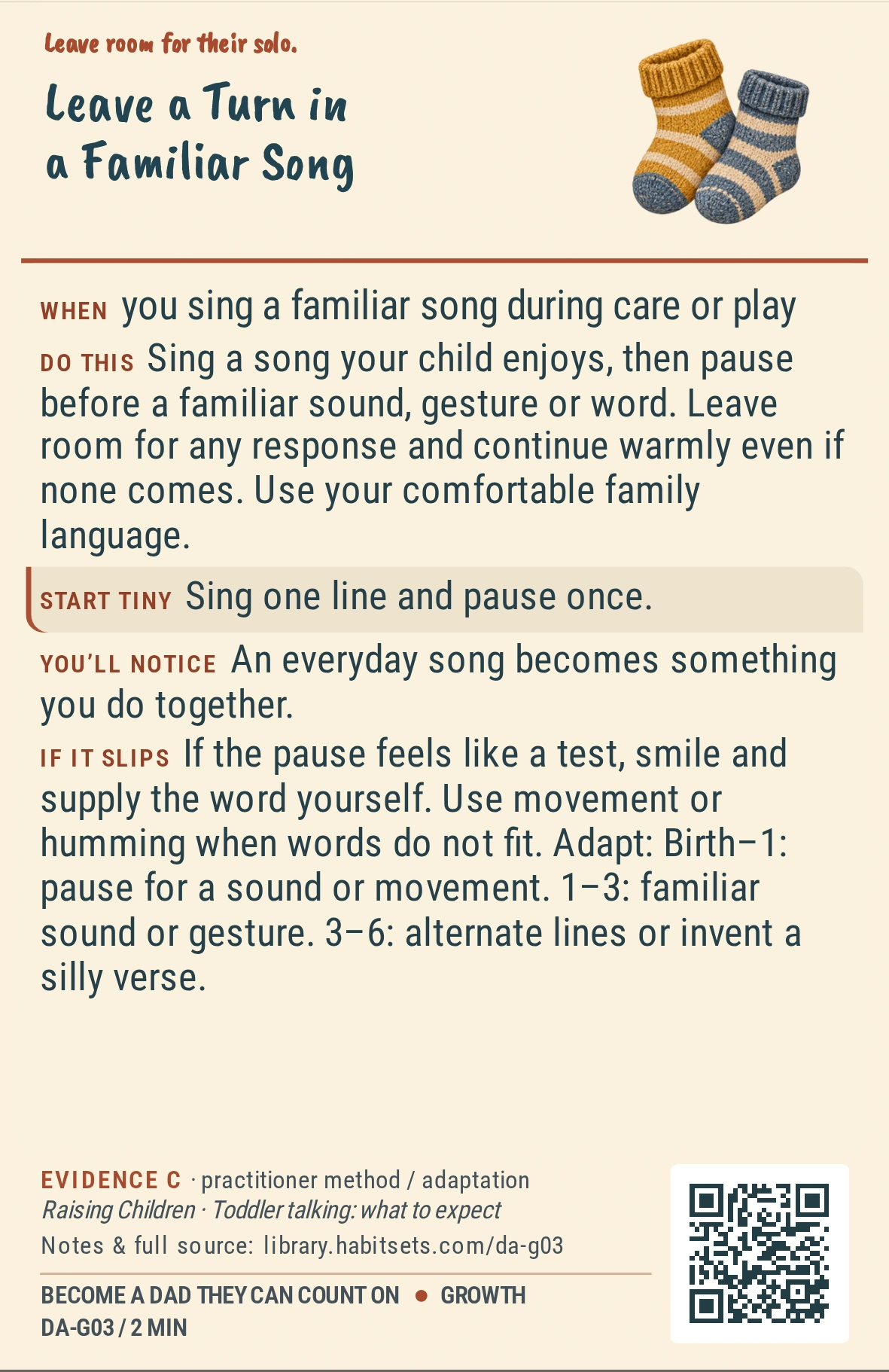
Front of DA-G03Back of card DA-G03: Leave a Turn in a Familiar Song. When: you sing a familiar song during care or play Do this: Sing a song your child enjoys, then pause before a familiar sound, gesture or word. Leave room for any response and continue warmly even if none comes. Use your comfortable family language. Start tiny: Sing one line and pause once.
50mm · DA-G03 · actual size
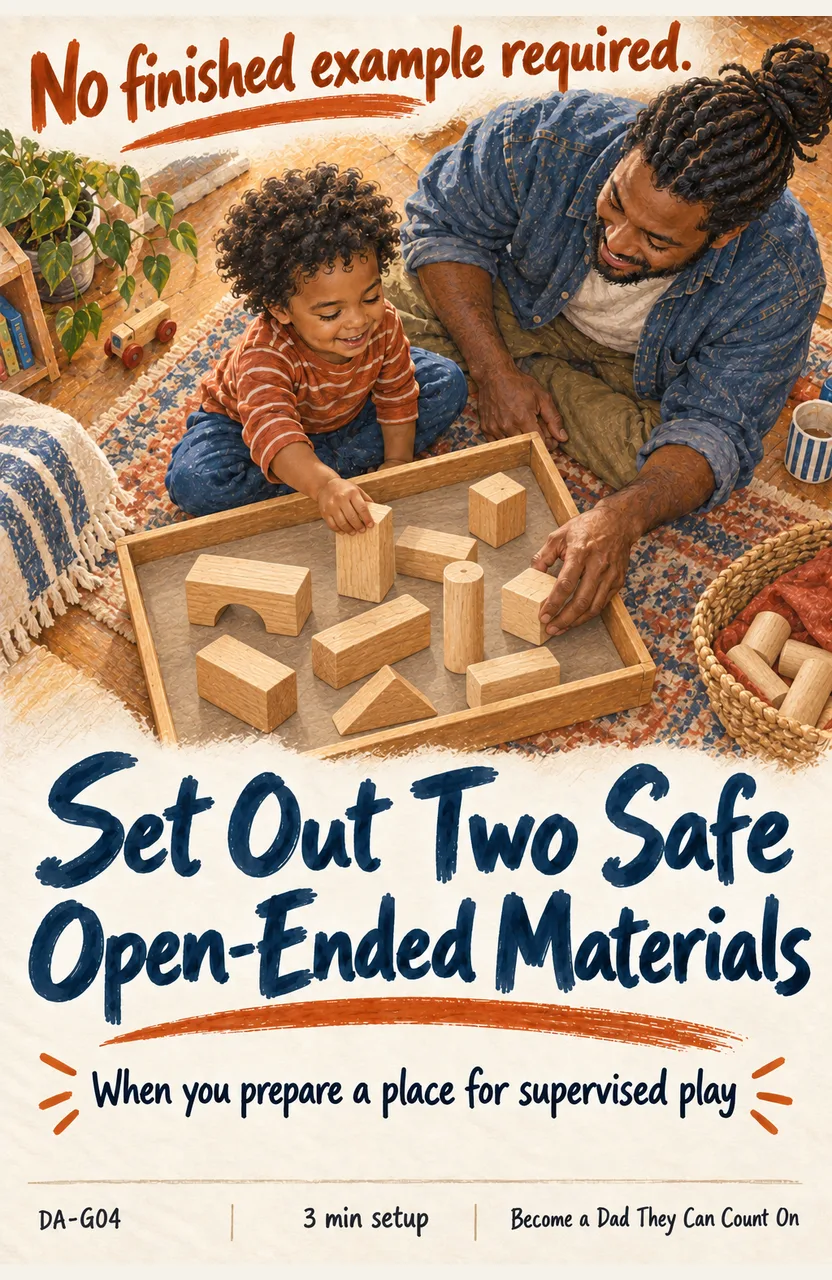
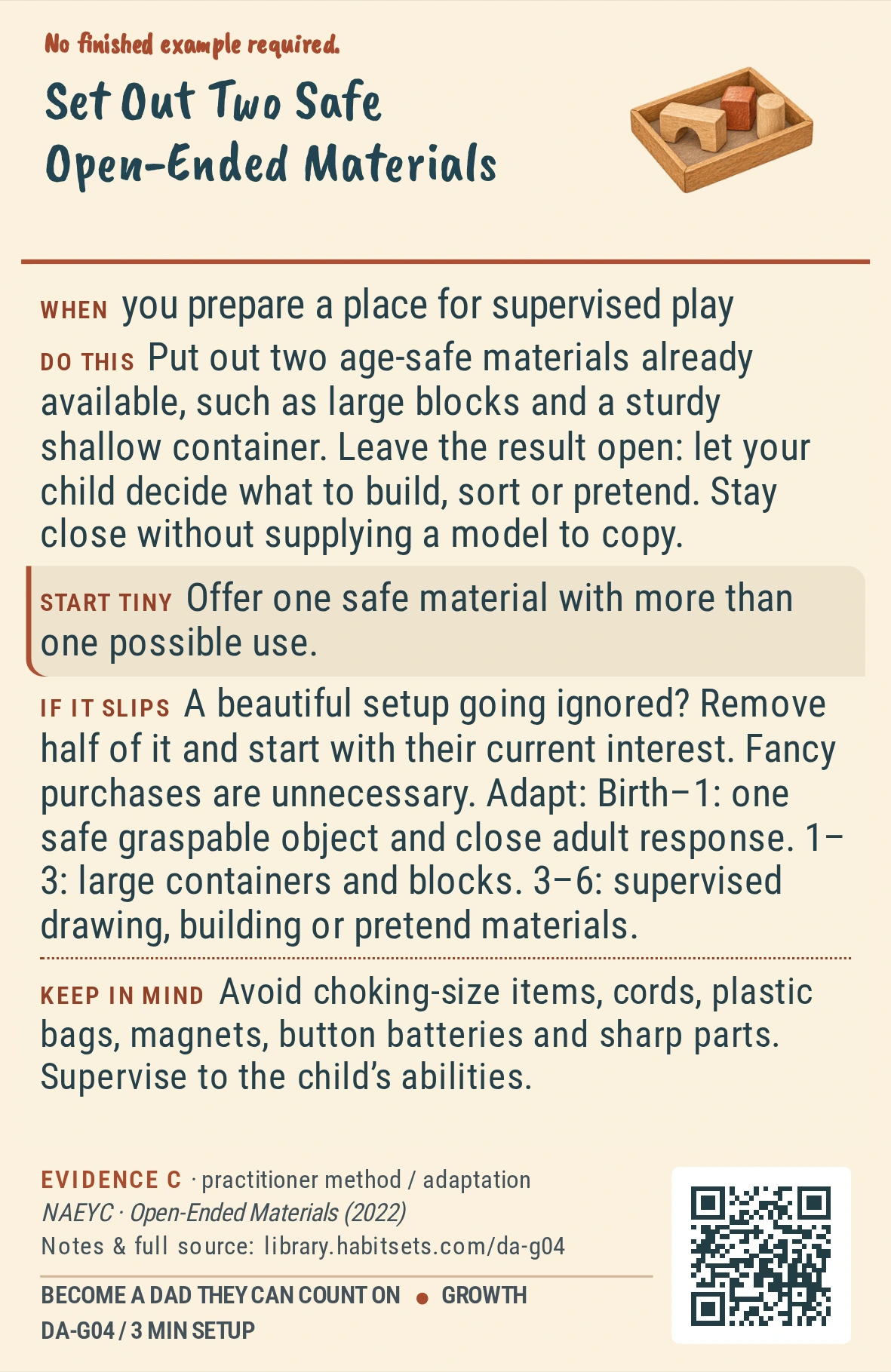
Front of DA-G04Back of card DA-G04: Set Out Two Safe Open-Ended Materials. When: you prepare a place for supervised play Do this: Put out two age-safe materials already available, such as large blocks and a sturdy shallow container. Leave the result open: let your child decide what to build, sort or pretend. Stay close without supplying a model to copy. Start tiny: Offer one safe material with more than one possible use. Keep in mind: Avoid choking-size items, cords, plastic bags, magnets, button batteries and sharp parts. Supervise to the child’s abilities.
50mm · DA-G04 · actual size
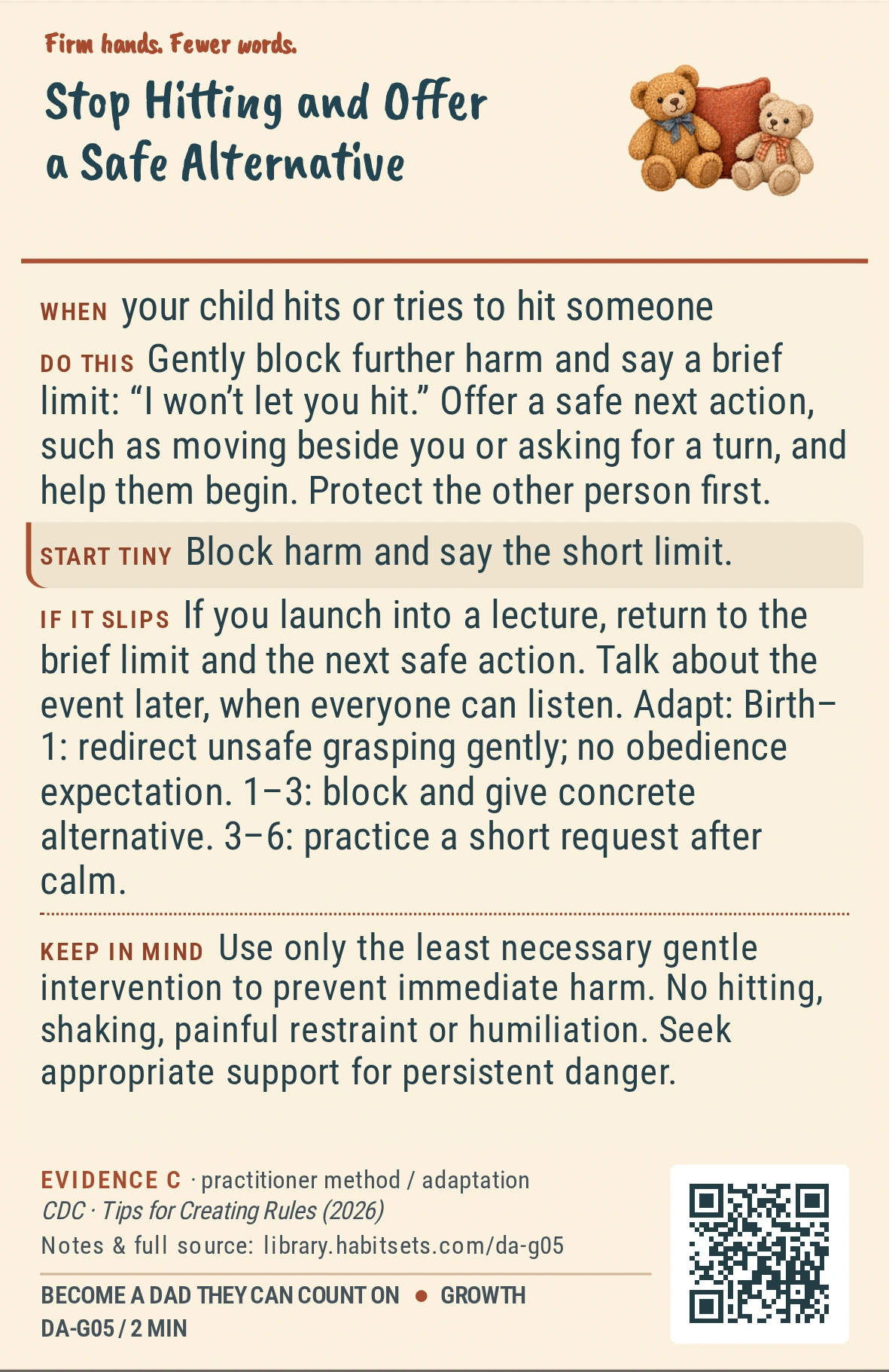
Front of DA-G05Back of card DA-G05: Stop Hitting and Offer a Safe Alternative. When: your child hits or tries to hit someone Do this: Gently block further harm and say a brief limit: “I won’t let you hit.” Offer a safe next action, such as moving beside you or asking for a turn, and help them begin. Protect the other person first. Start tiny: Block harm and say the short limit. Keep in mind: Use only the least necessary gentle intervention to prevent immediate harm. No hitting, shaking, painful restraint or humiliation. Seek appropriate support for persistent danger.
50mm · DA-G05 · actual size
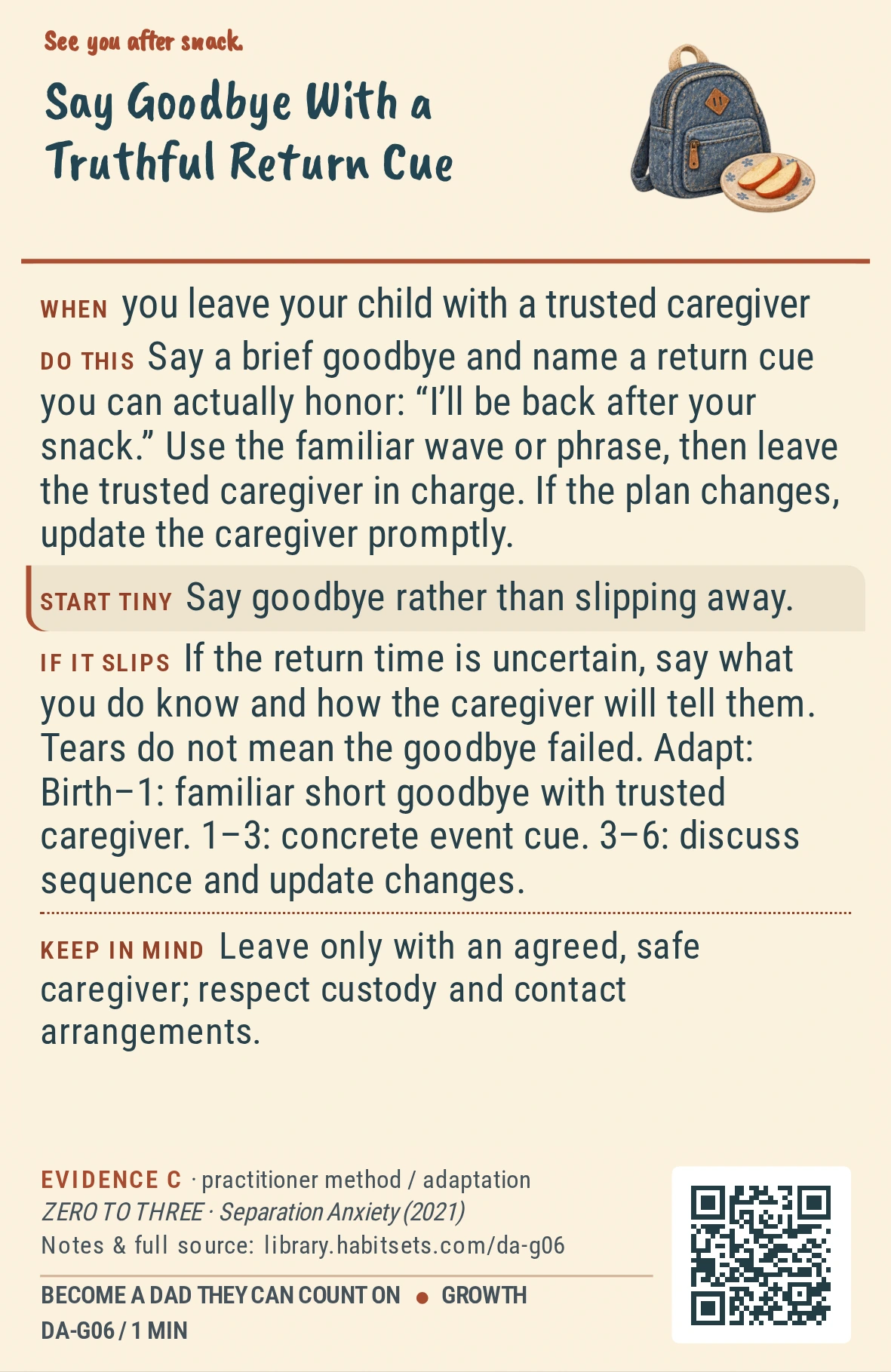
Front of DA-G06Back of card DA-G06: Say Goodbye With a Truthful Return Cue. When: you leave your child with a trusted caregiver Do this: Say a brief goodbye and name a return cue you can actually honor: “I’ll be back after your snack.” Use the familiar wave or phrase, then leave the trusted caregiver in charge. If the plan changes, update the caregiver promptly. Start tiny: Say goodbye rather than slipping away. Keep in mind: Leave only with an agreed, safe caregiver; respect custody and contact arrangements.
50mm · DA-G06 · actual size
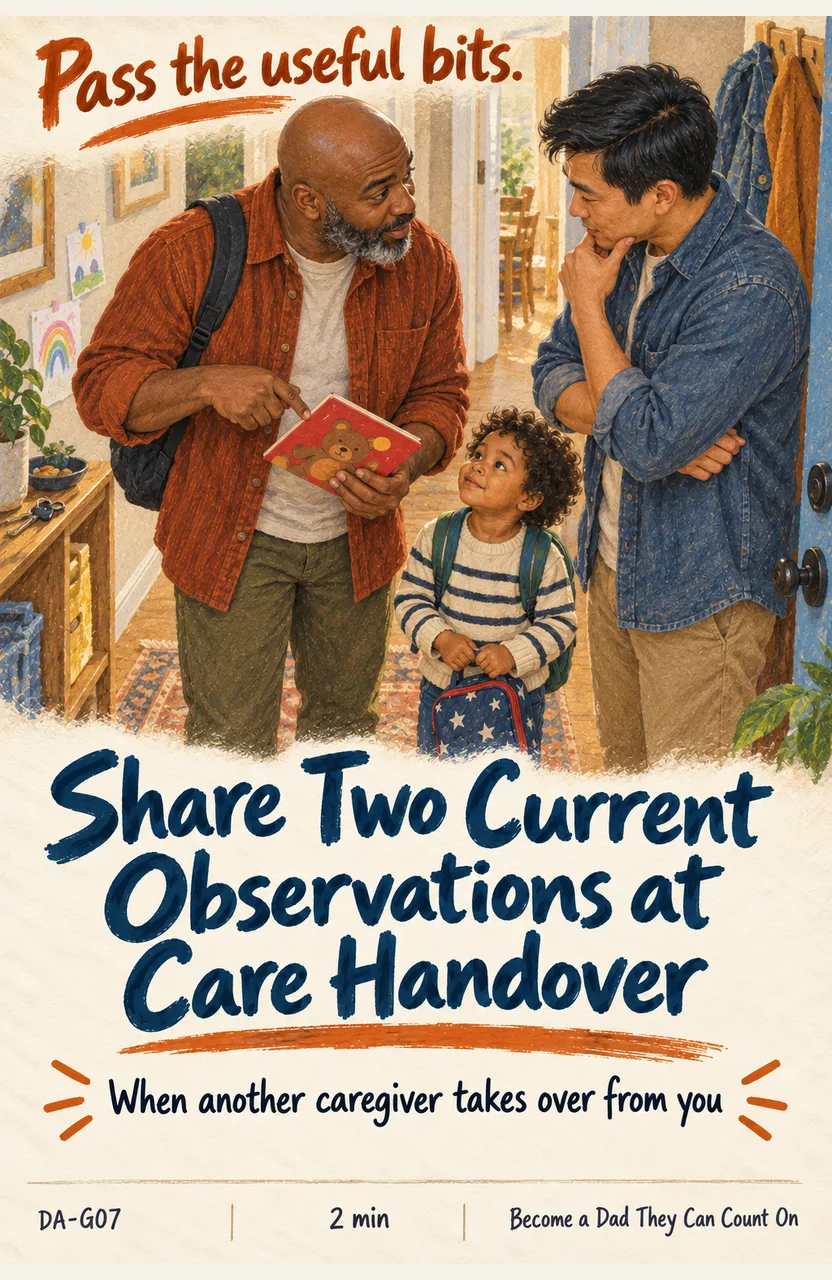
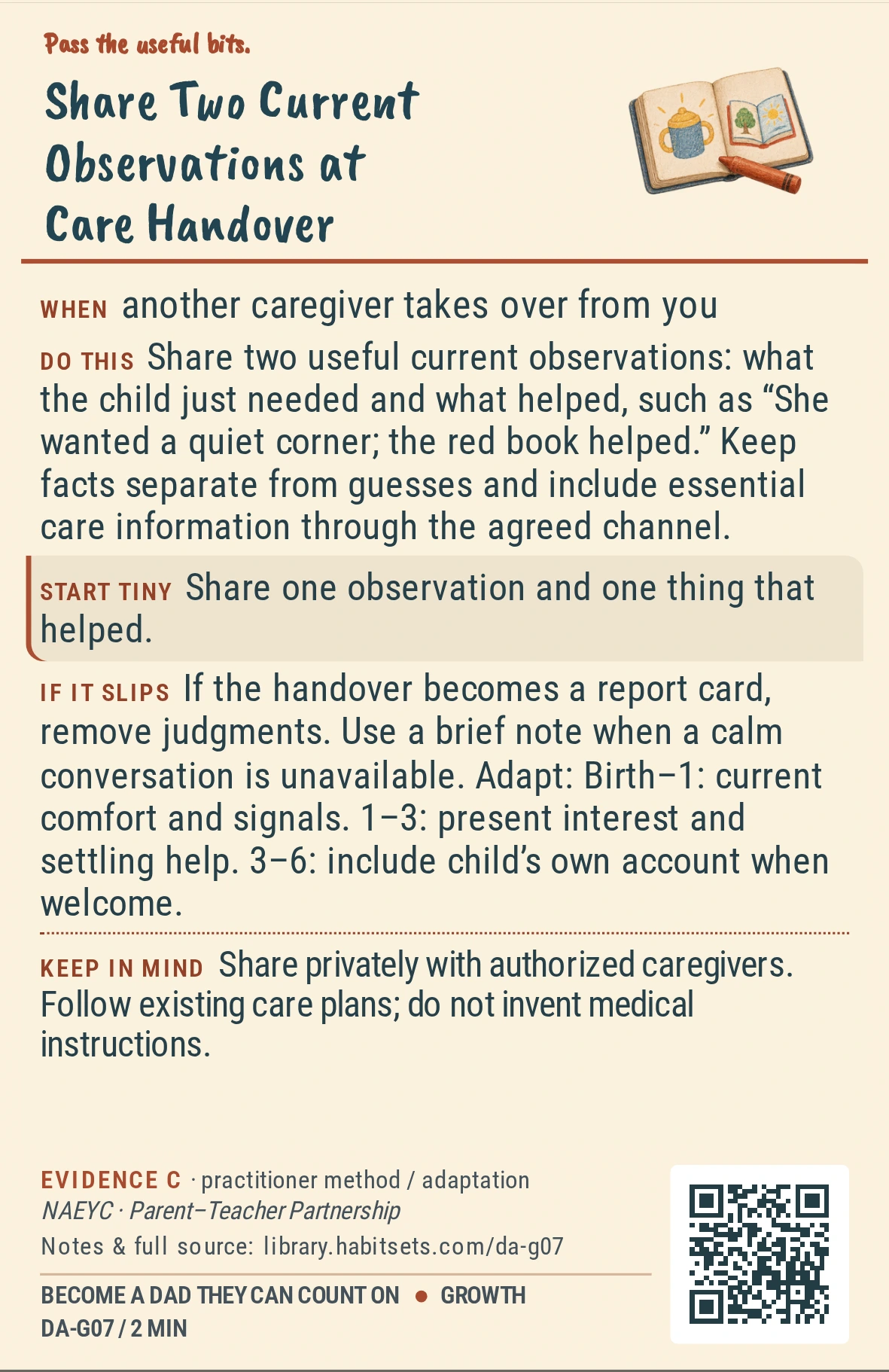
Front of DA-G07Back of card DA-G07: Share Two Current Observations at Care Handover. When: another caregiver takes over from you Do this: Share two useful current observations: what the child just needed and what helped, such as “She wanted a quiet corner; the red book helped.” Keep facts separate from guesses and include essential care information through the agreed channel. Start tiny: Share one observation and one thing that helped. Keep in mind: Share privately with authorized caregivers. Follow existing care plans; do not invent medical instructions.
50mm · DA-G07 · actual size
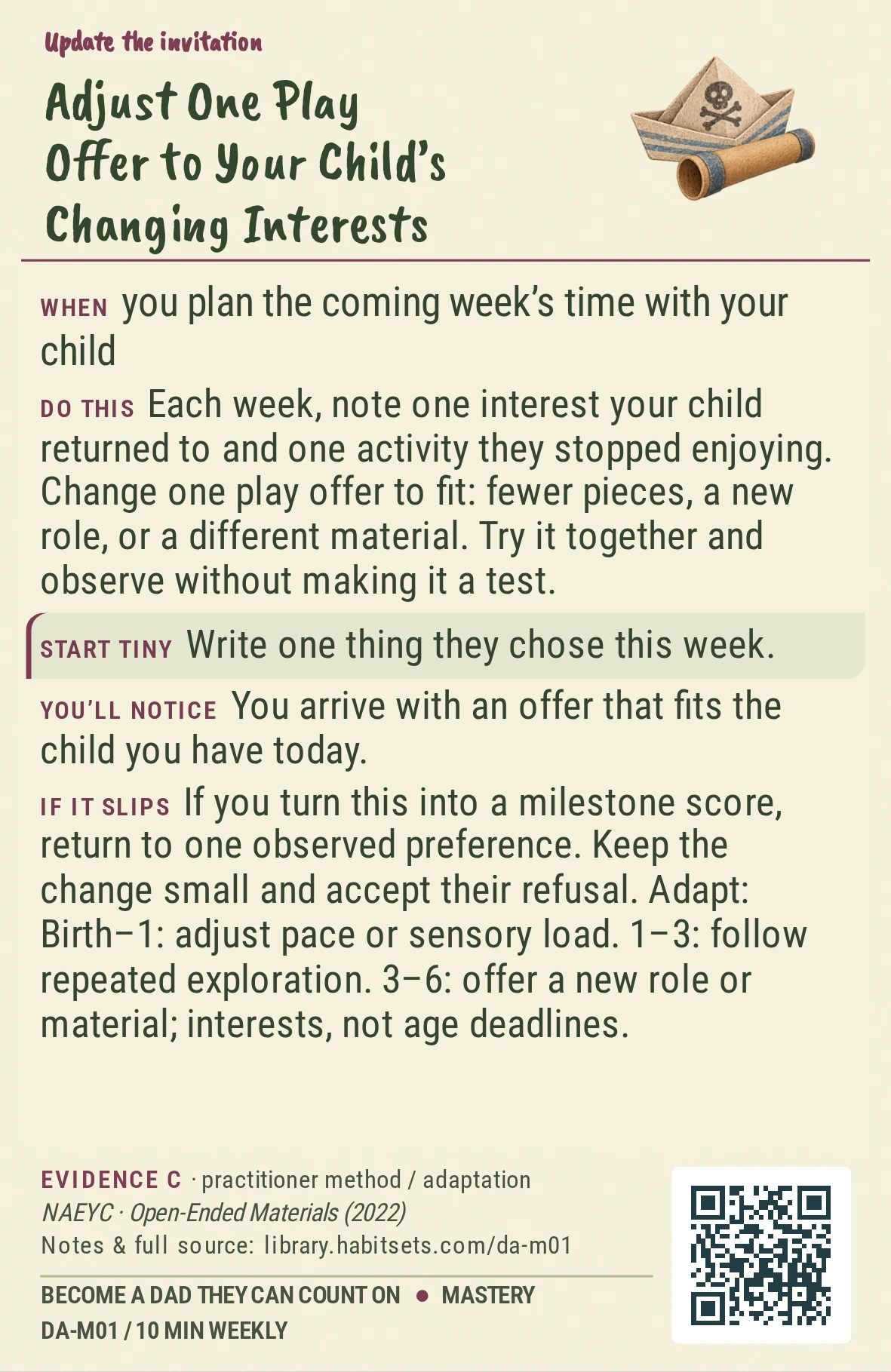
Front of DA-M01Back of card DA-M01: Adjust One Play Offer to Your Child’s Changing Interests. When: you plan the coming week’s time with your child Do this: Each week, note one interest your child returned to and one activity they stopped enjoying. Change one play offer to fit: fewer pieces, a new role, or a different material. Try it together and observe without making it a test. Start tiny: Write one thing they chose this week.
50mm · DA-M01 · actual size
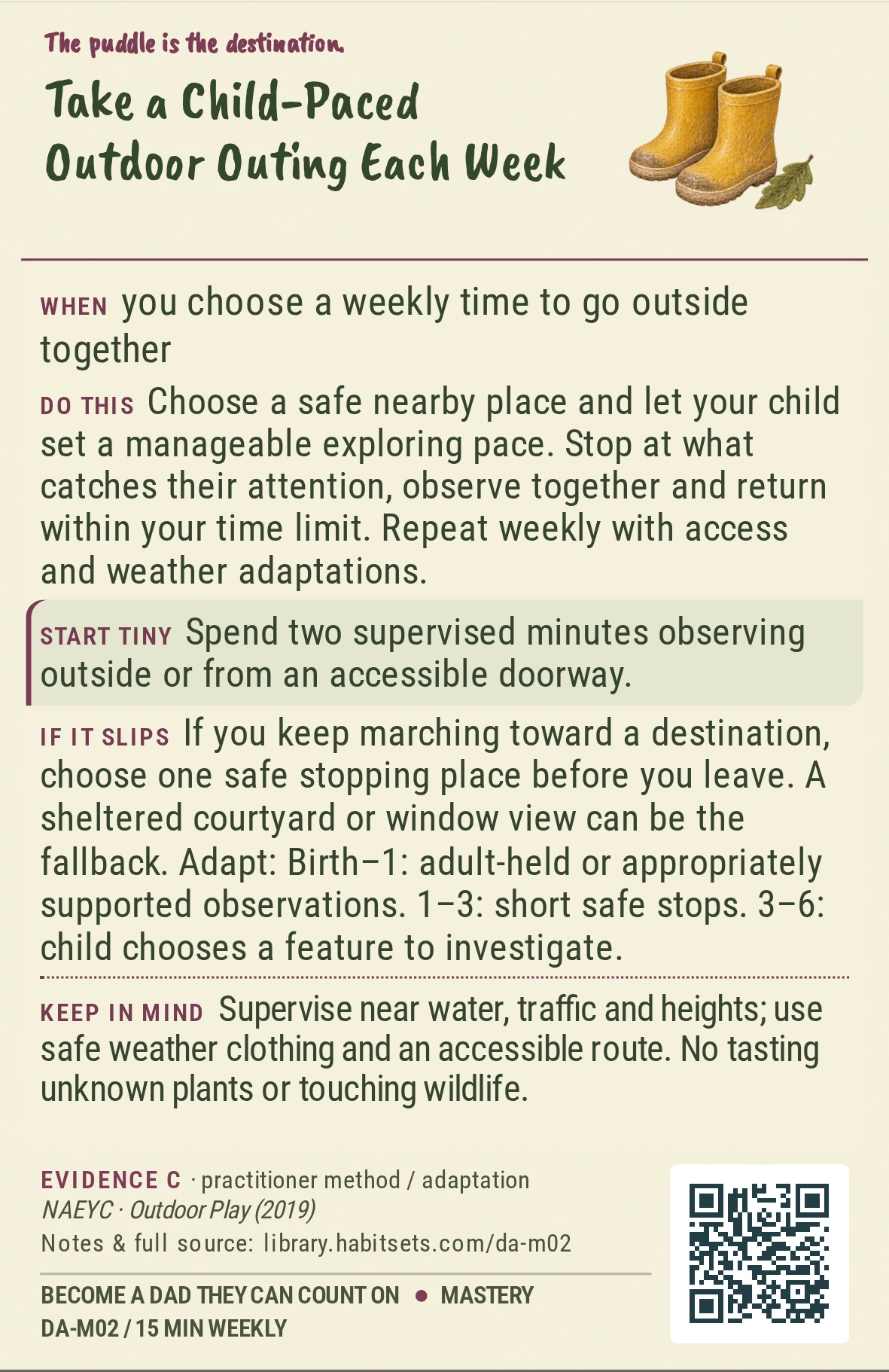
Front of DA-M02Back of card DA-M02: Take a Child-Paced Outdoor Outing Each Week. When: you choose a weekly time to go outside together Do this: Choose a safe nearby place and let your child set a manageable exploring pace. Stop at what catches their attention, observe together and return within your time limit. Repeat weekly with access and weather adaptations. Start tiny: Spend two supervised minutes observing outside or from an accessible doorway. Keep in mind: Supervise near water, traffic and heights; use safe weather clothing and an accessible route. No tasting unknown plants or touching wildlife.
50mm · DA-M02 · actual size
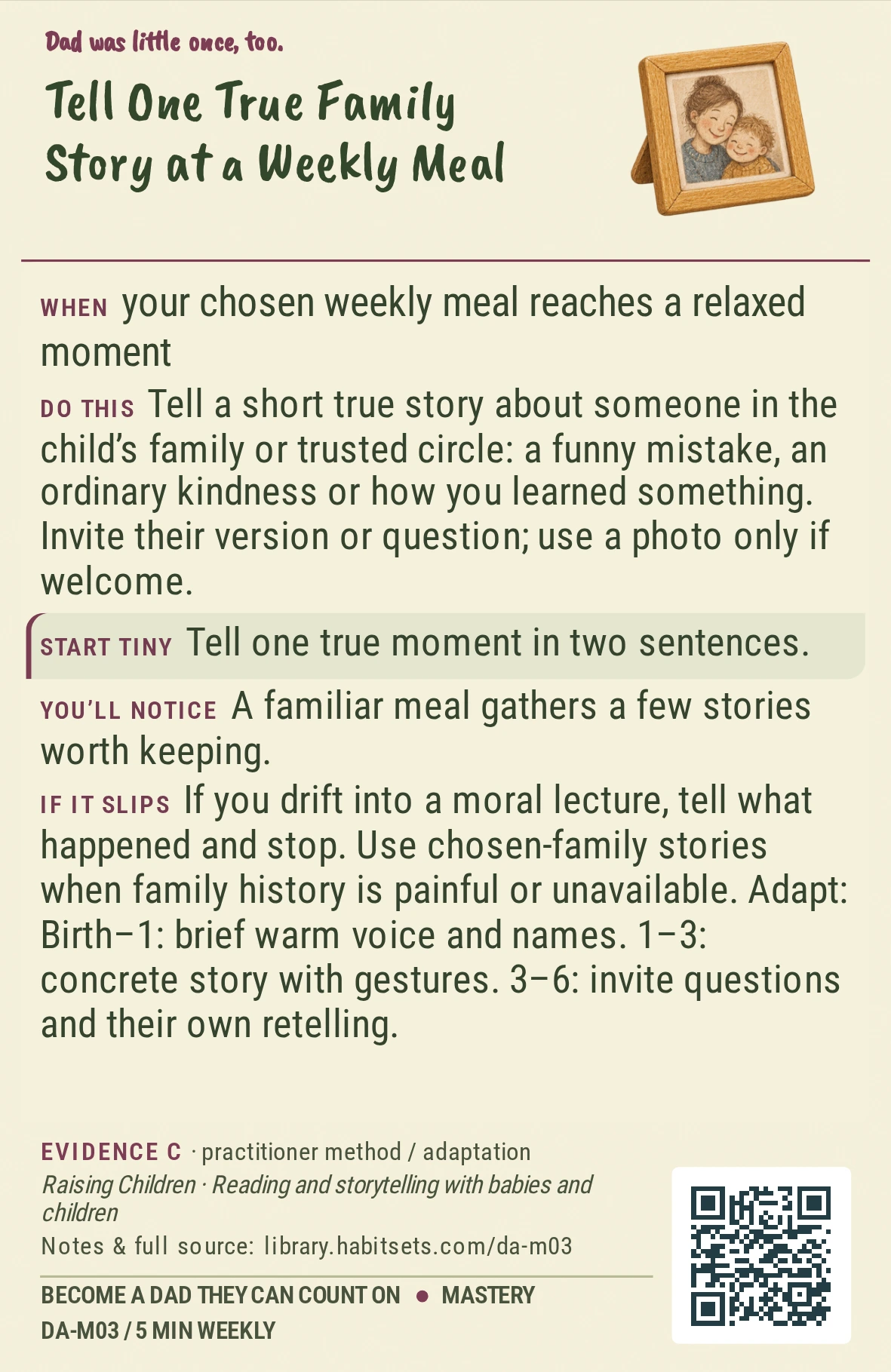
Front of DA-M03Back of card DA-M03: Tell One True Family Story at a Weekly Meal. When: your chosen weekly meal reaches a relaxed moment Do this: Tell a short true story about someone in the child’s family or trusted circle: a funny mistake, an ordinary kindness or how you learned something. Invite their version or question; use a photo only if welcome. Start tiny: Tell one true moment in two sentences.
50mm · DA-M03 · actual size
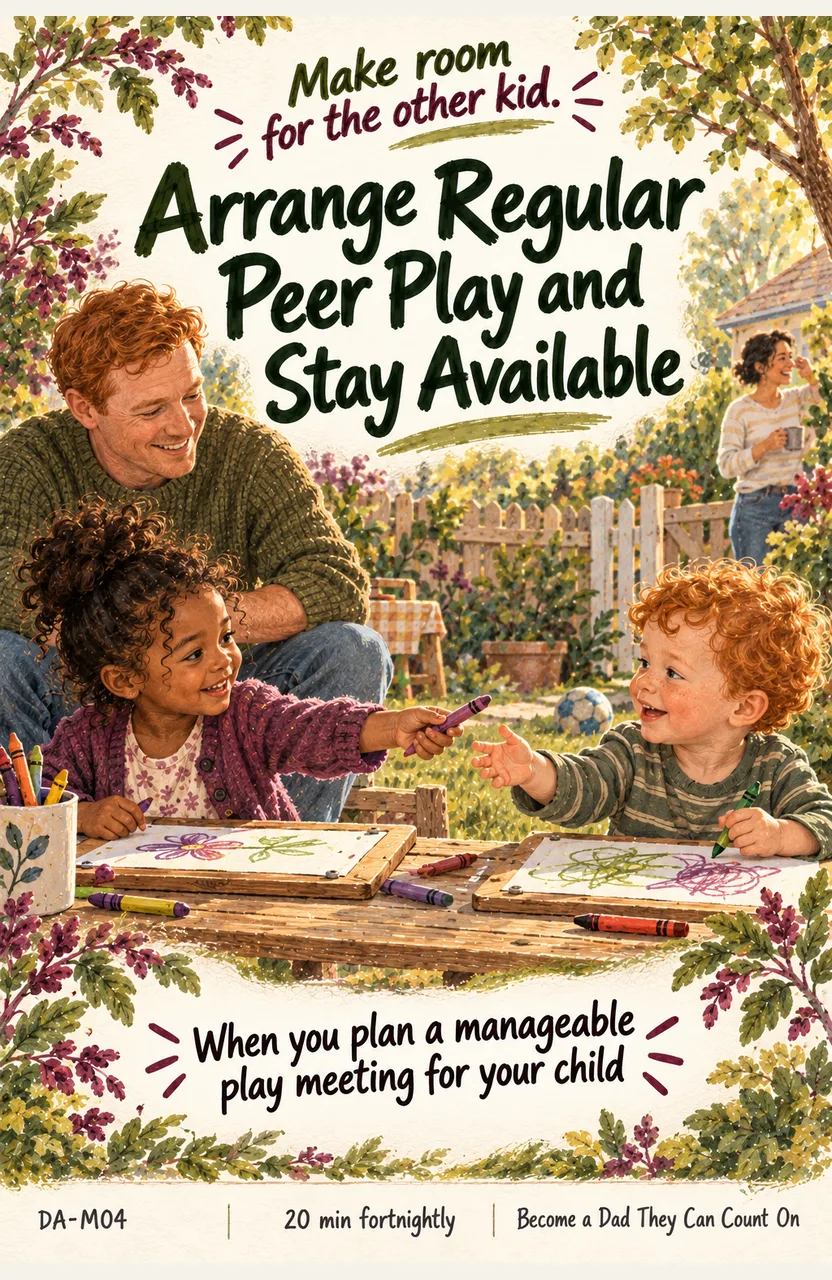
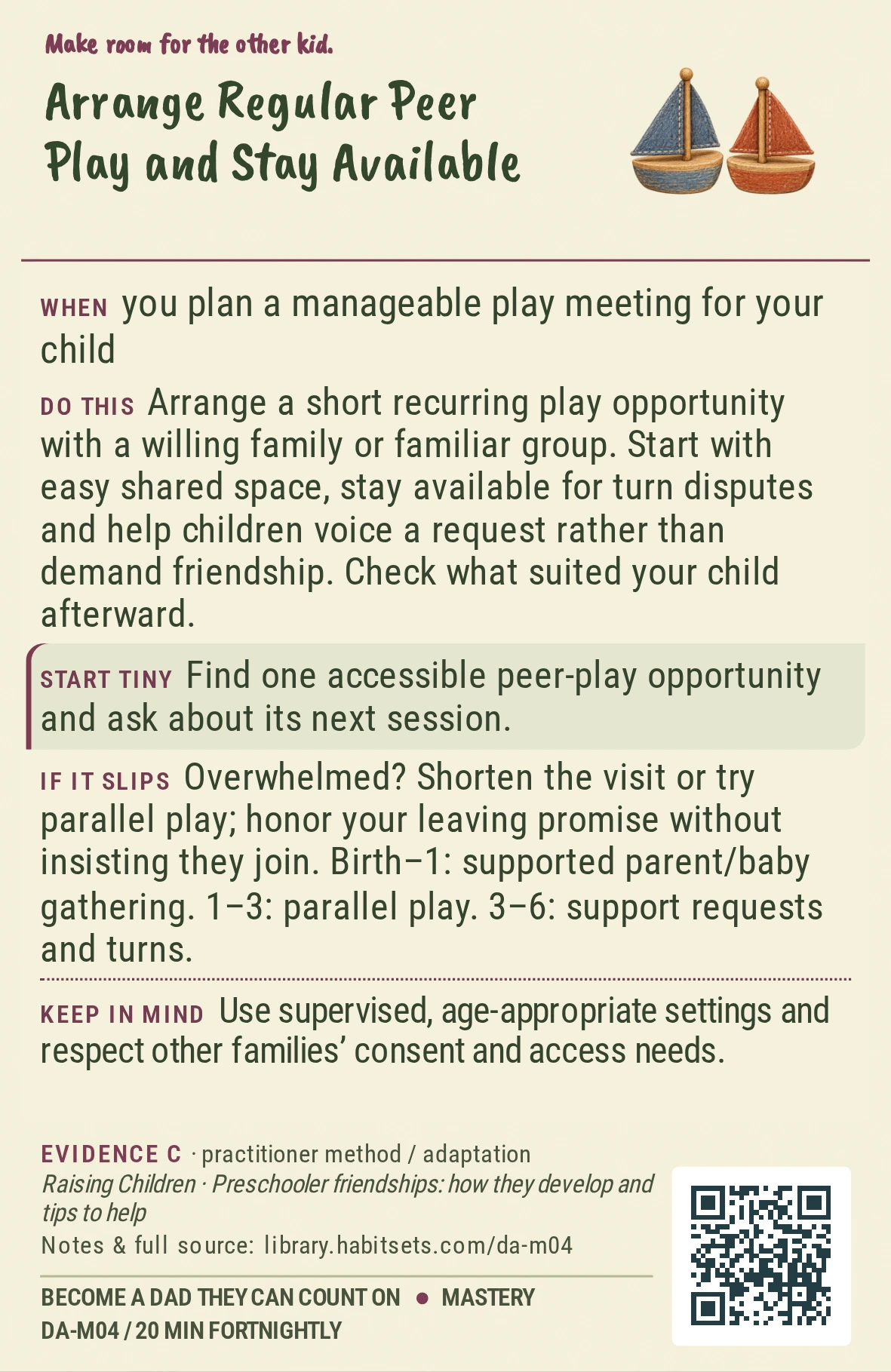
Front of DA-M04Back of card DA-M04: Arrange Regular Peer Play and Stay Available. When: you plan a manageable play meeting for your child Do this: Arrange a short recurring play opportunity with a willing family or familiar group. Start with easy shared space, stay available for turn disputes and help children voice a request rather than demand friendship. Check what suited your child afterward. Start tiny: Find one accessible peer-play opportunity and ask about its next session. Keep in mind: Use supervised, age-appropriate settings and respect other families’ consent and access needs.
50mm · DA-M04 · actual size
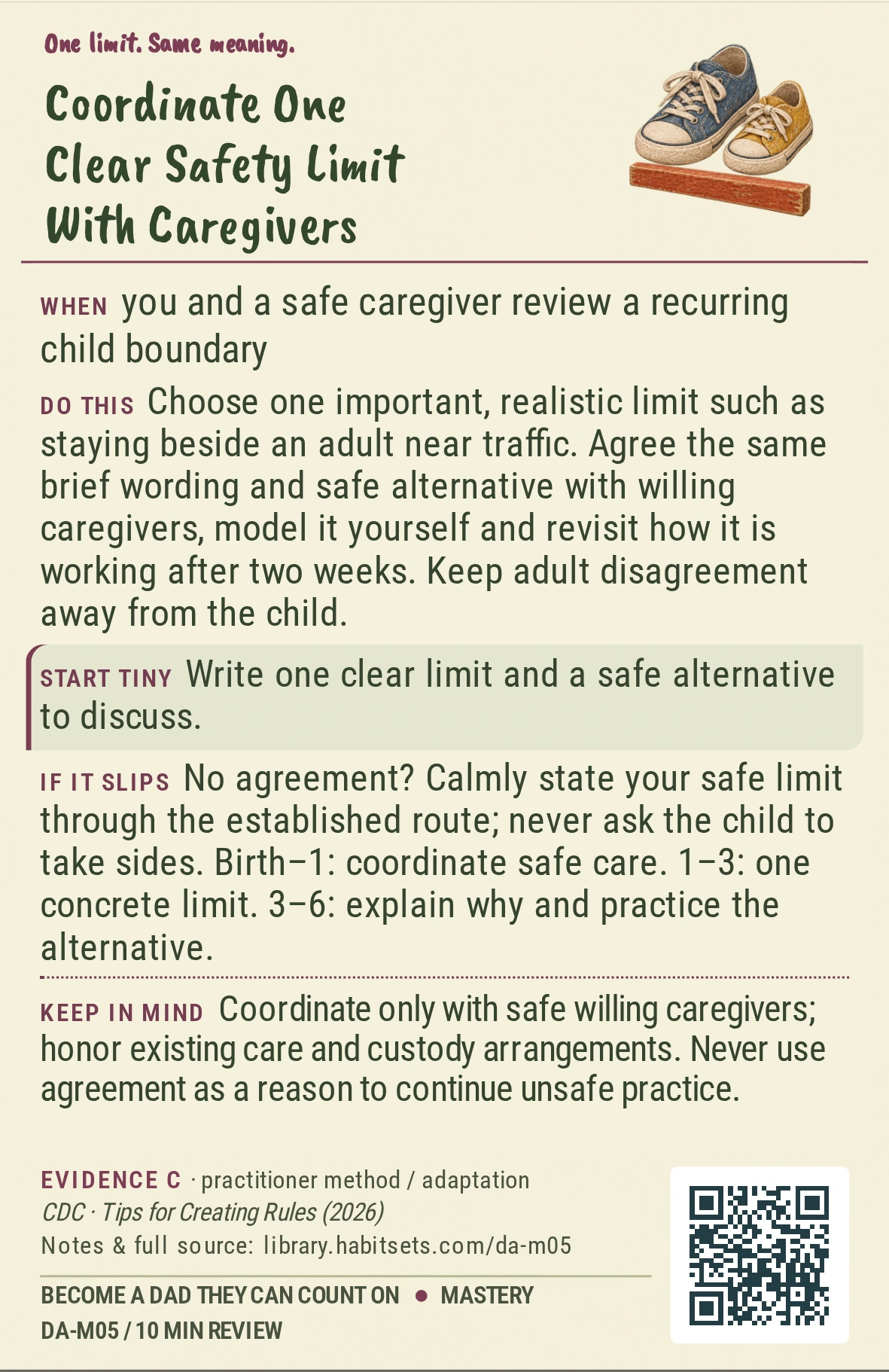
Front of DA-M05Back of card DA-M05: Coordinate One Clear Safety Limit With Caregivers. When: you and a safe caregiver review a recurring child boundary Do this: Choose one important, realistic limit such as staying beside an adult near traffic. Agree the same brief wording and safe alternative with willing caregivers, model it yourself and revisit how it is working after two weeks. Keep adult disagreement away from the child. Start tiny: Write one clear limit and a safe alternative to discuss. Keep in mind: Coordinate only with safe willing caregivers; honor existing care and custody arrangements. Never use agreement as a reason to continue unsafe practice.
50mm · DA-M05 · actual size
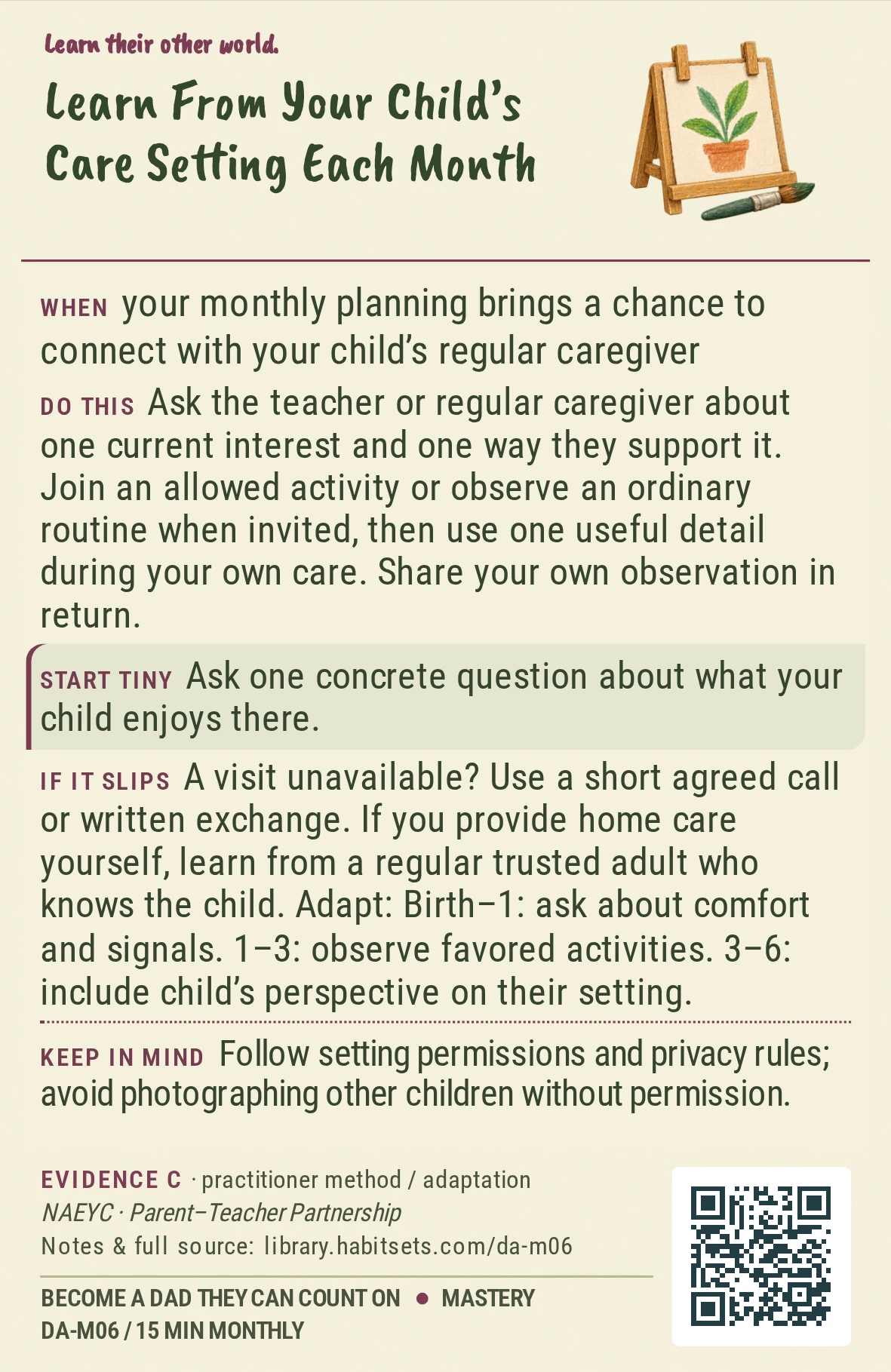
Front of DA-M06Back of card DA-M06: Learn From Your Child’s Care Setting Each Month. When: your monthly planning brings a chance to connect with your child’s regular caregiver Do this: Ask the teacher or regular caregiver about one current interest and one way they support it. Join an allowed activity or observe an ordinary routine when invited, then use one useful detail during your own care. Share your own observation in return. Start tiny: Ask one concrete question about what your child enjoys there. Keep in mind: Follow setting permissions and privacy rules; avoid photographing other children without permission.
50mm · DA-M06 · actual size
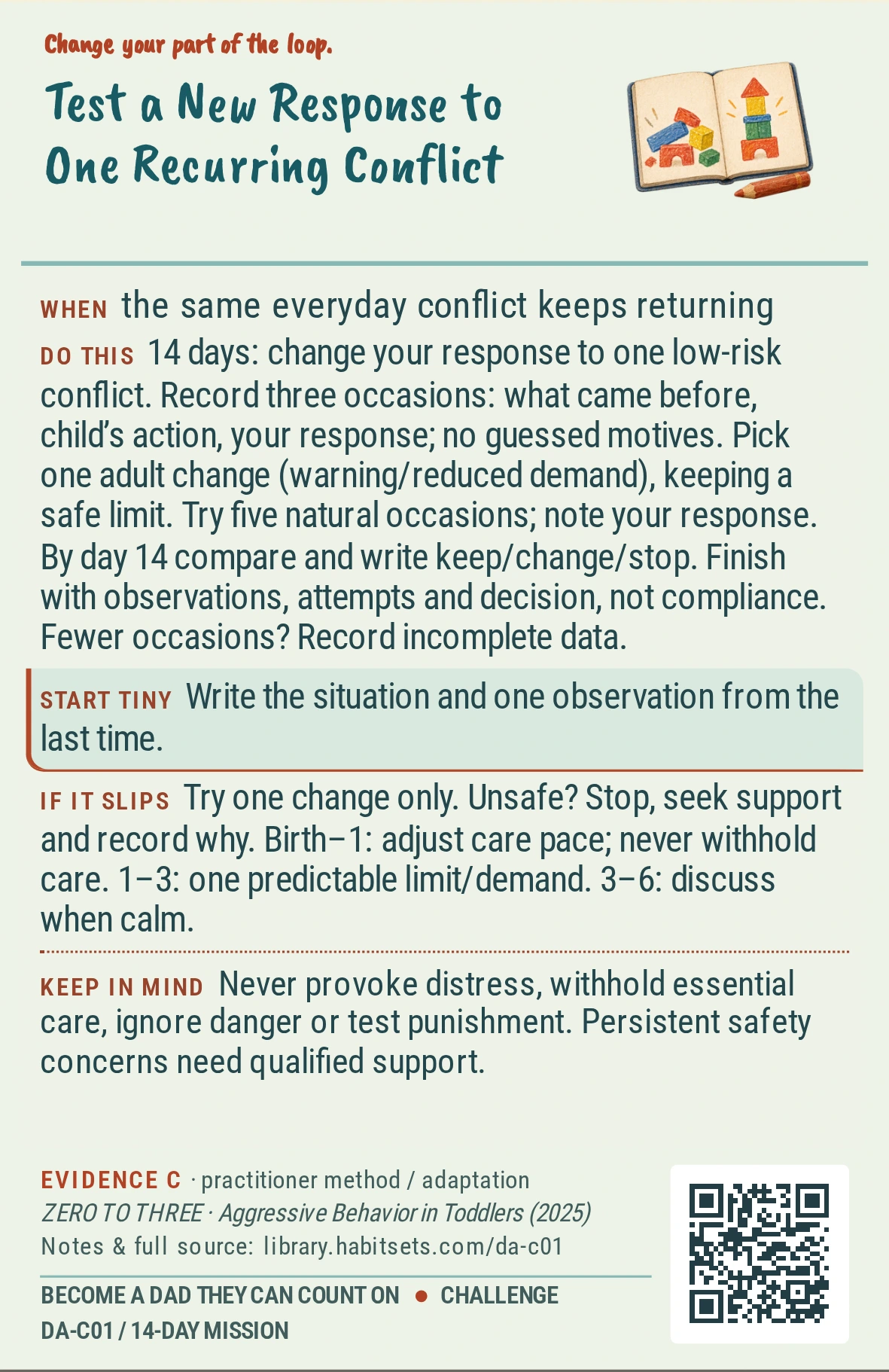
Front of DA-C01Back of card DA-C01: Test a New Response to One Recurring Conflict. When: the same everyday conflict keeps returning Do this: Goal: change your own response to one recurring low-risk conflict. Window: 14 days.
1. On three occasions, record what happened just before, what your child did and what you did; leave guessed motives out.
2. Choose one adult change, such as offering a transition warning or reducing a demand, and keep a clear safe limit.
3. Try the change on five naturally occurring occasions, noting your actual response.
4. By day 14, compare the observations and choose keep, change or stop.
Finish after the observations, five adult attempts and a written decision; child compliance is not required. If five occasions do not arise, close with the attempts you had and an explicit incomplete-data decision. Start tiny: Write the situation and one observation from the last time. Keep in mind: Never provoke distress, withhold essential care, ignore danger or test punishment. Persistent safety concerns need qualified support.
50mm · DA-C01 · actual size
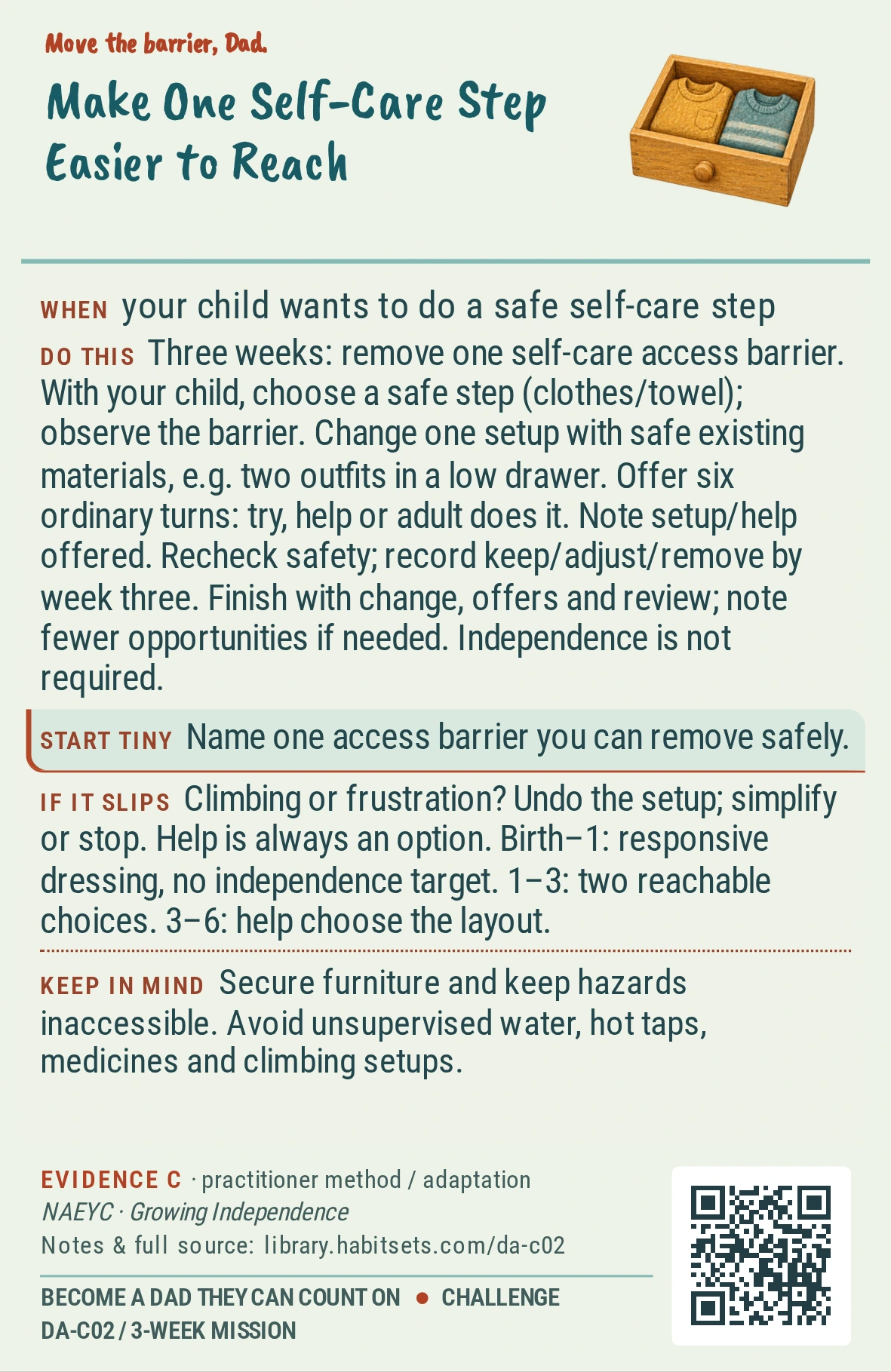
Front of DA-C02Back of card DA-C02: Make One Self-Care Step Easier to Reach. When: your child wants to do a safe self-care step Do this: Goal: remove an adult-created access barrier to one self-care step. Window: three weeks.
1. Choose with your child a safe step such as selecting clothes or reaching a towel; observe what blocks access.
2. Change one physical setup with existing safe materials, such as putting two outfits in a low drawer.
3. On six ordinary opportunities, offer a choice of trying, getting help or having you do it; note which setup and help you offered.
4. Recheck safety and decide keep, adjust or remove the setup by week three.
Finish after the access change, six respectful offers and your recorded decision. If opportunities are fewer, finish the review with that limit stated; independent completion is never required. Start tiny: Name one access barrier you can remove safely. Keep in mind: Secure furniture and keep hazards inaccessible. Avoid unsupervised water, hot taps, medicines and climbing setups.
50mm · DA-C02 · actual size
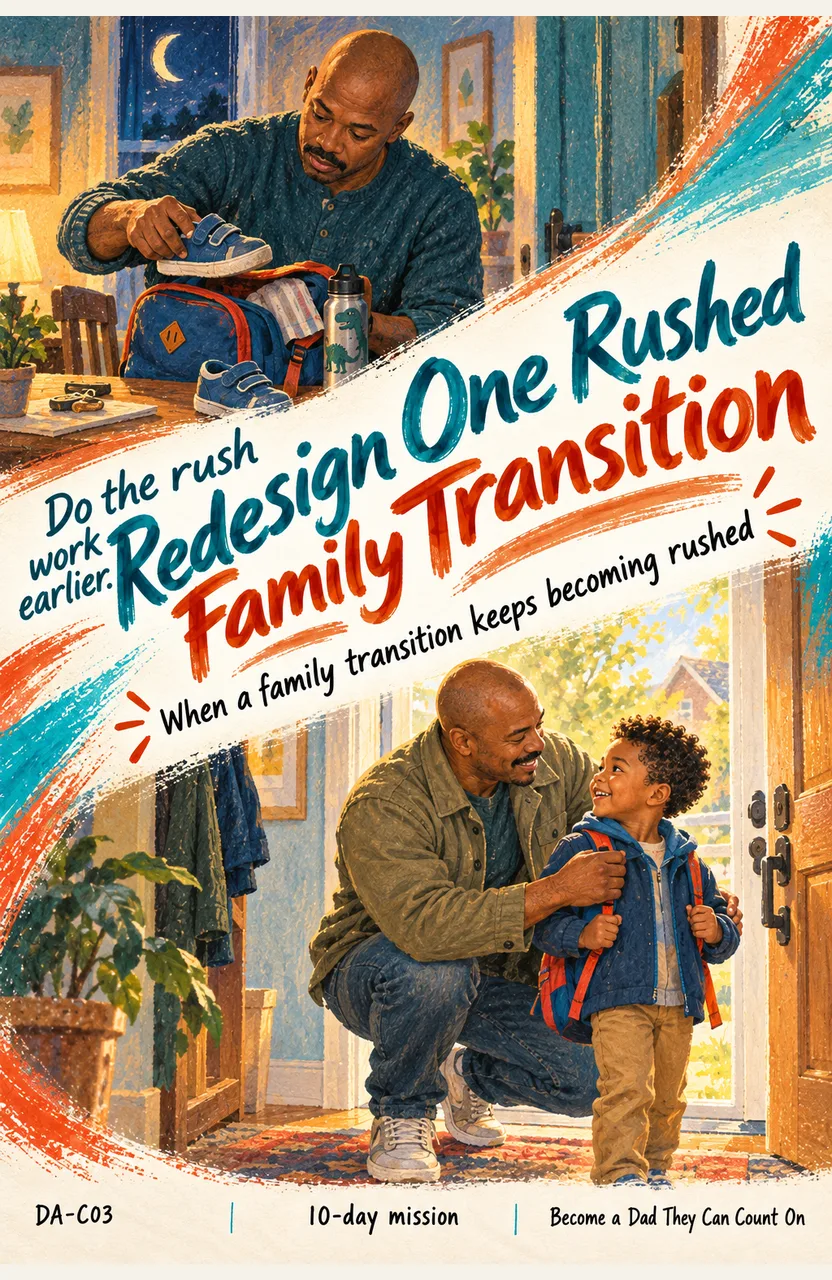
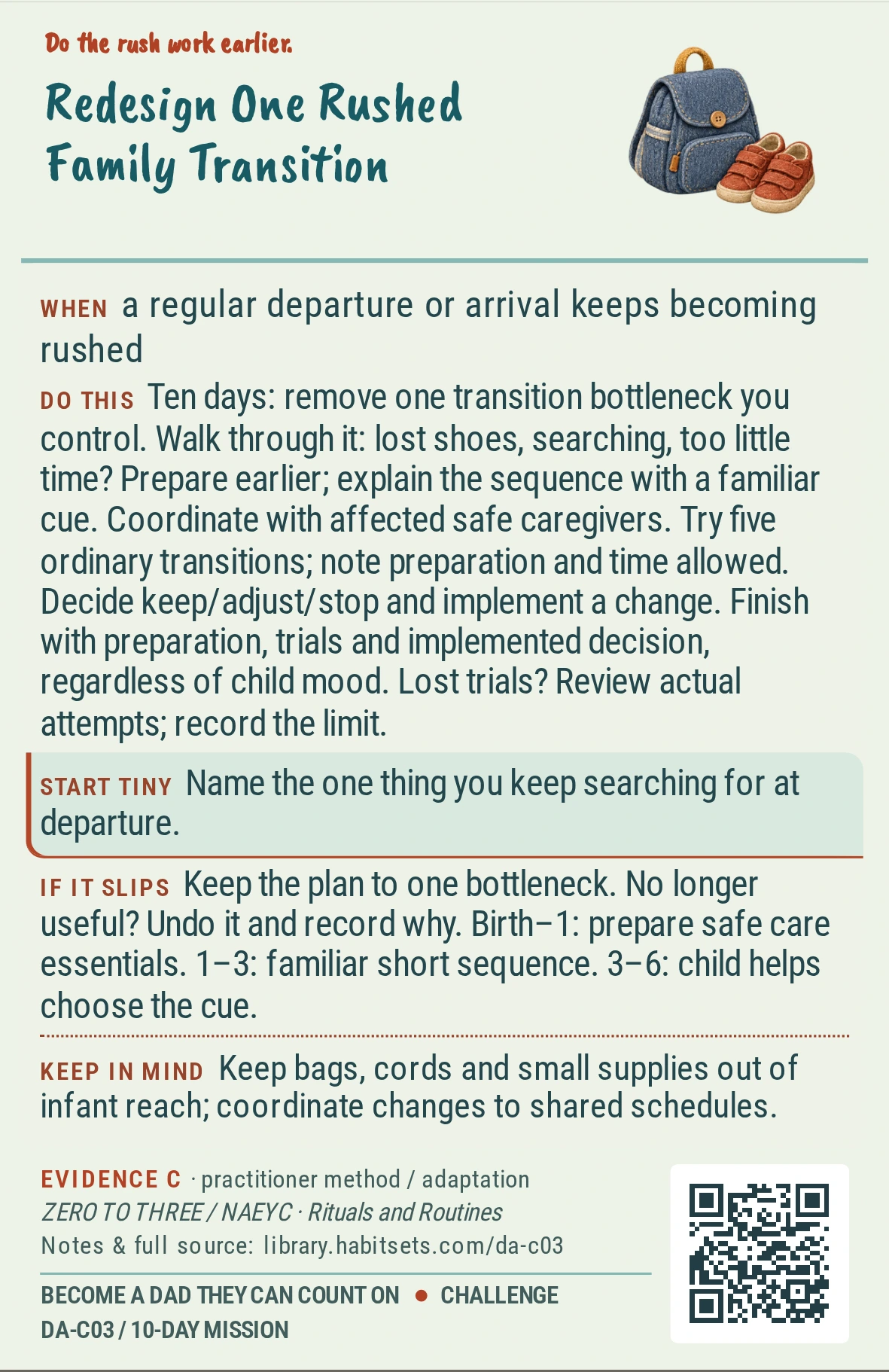
Front of DA-C03Back of card DA-C03: Redesign One Rushed Family Transition. When: a regular departure or arrival keeps becoming rushed Do this: Goal: remove one adult logistics bottleneck from a recurring transition. Window: ten days.
1. Walk through the transition yourself and name the bottleneck you control: missing shoes, a last-minute search or an unrealistic departure plan.
2. Prepare that element earlier and explain the sequence to your child with one familiar cue. Coordinate with any affected safe caregiver.
3. Try the arrangement on five ordinary transitions; record what you prepared and whether your plan left enough time.
4. At the end, decide keep, adjust or stop and carry out one chosen change.
Finish with the preparation, five trials and implemented decision, regardless of your child’s mood. If circumstances remove trials, review the actual attempts and close with the limit stated. Start tiny: Name the one thing you keep searching for at departure. Keep in mind: Keep bags, cords and small supplies out of infant reach; coordinate changes to shared schedules.
50mm · DA-C03 · actual size
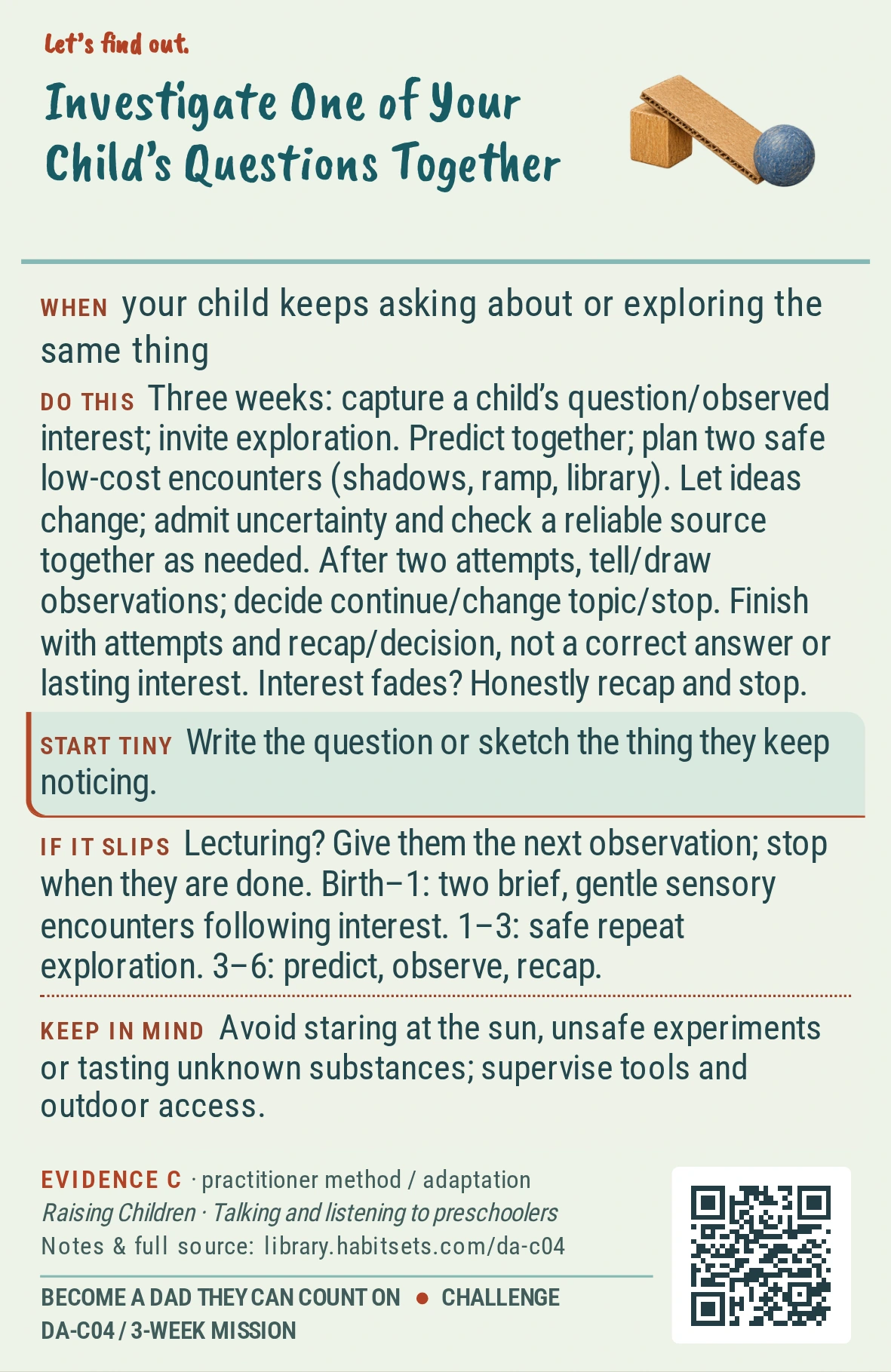
Front of DA-C04Back of card DA-C04: Investigate One of Your Child’s Questions Together. When: your child keeps asking about or exploring the same thing Do this: Goal: follow one child interest through shared discovery. Window: three weeks.
1. Capture their question, or an interest you can observe, and ask whether they want to explore it with you.
2. Make a simple prediction together, then plan two safe low-cost encounters: watch shadows twice, test a ramp or visit the library for an answer.
3. Let the child change their idea; say what you do not know and check a reliable source together when needed.
4. After two encounters, tell or draw what you noticed and choose continue, change topic or stop.
Finish after two shared attempts and your recap/decision; a correct answer or continued child interest is unnecessary. If they lose interest, finish with your honest recap and stop rather than push. Start tiny: Write the question or sketch the thing they keep noticing. Keep in mind: Avoid staring at the sun, unsafe experiments or tasting unknown substances; supervise tools and outdoor access.
50mm · DA-C04 · actual size
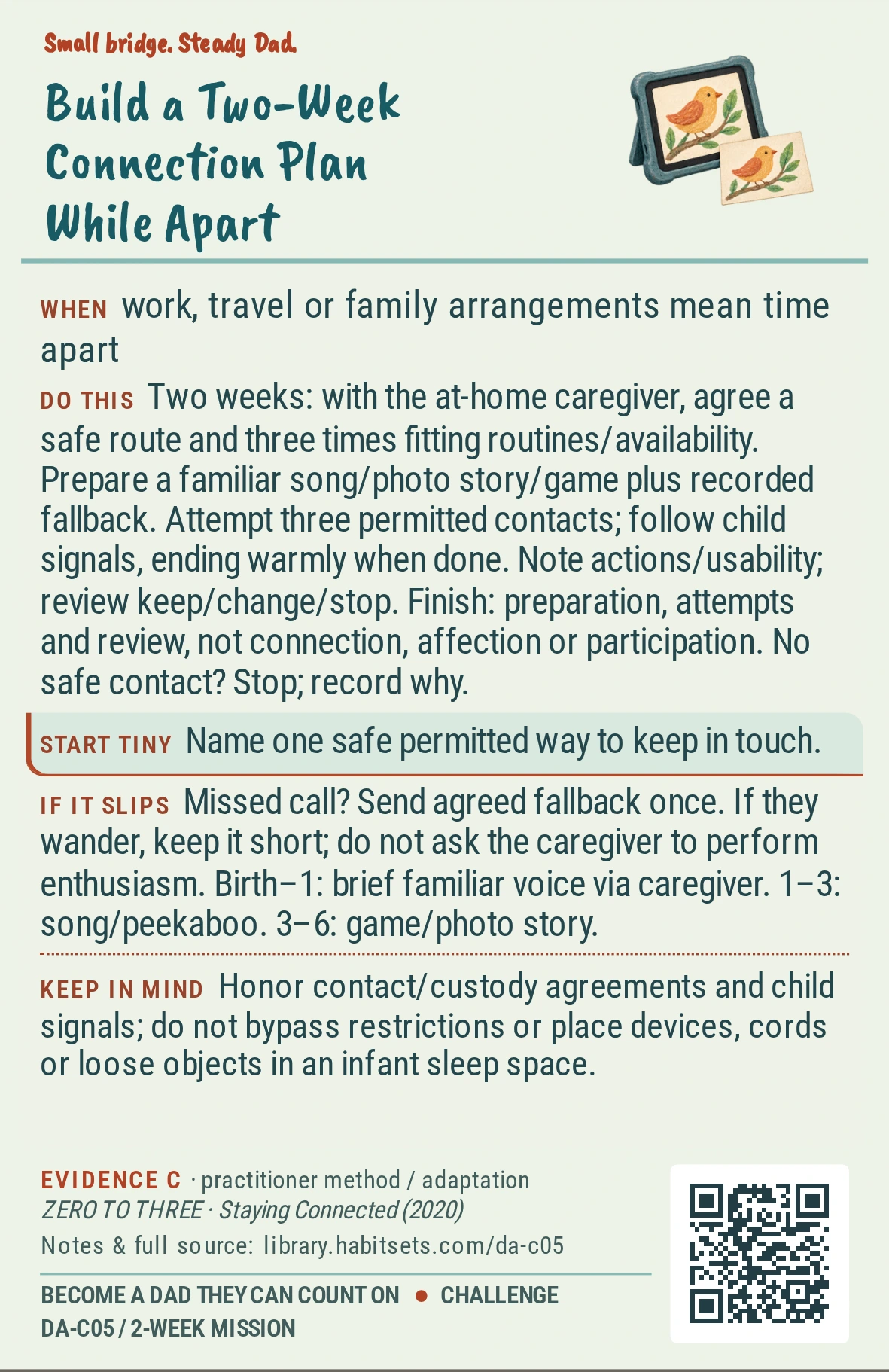
Front of DA-C05Back of card DA-C05: Build a Two-Week Connection Plan While Apart. When: work, travel or family arrangements mean time apart Do this: Goal: create dependable child-centered contact within safe agreed arrangements. Window: two weeks.
1. Agree with the at-home caregiver on a feasible contact route and three opportunities; fit the child’s routine and your real availability.
2. Prepare a familiar song, photo story or tiny shared game, plus a recorded message fallback.
3. Make three agreed contact attempts; follow the child’s signals and end warmly when they are done. Record what you did and what seemed usable.
4. Review after two weeks and propose a keep/change/stop plan.
Finish after preparation, three permitted attempts and your review; calls connecting, affection and child participation are not the finish. If safe contact is unavailable, stop and record that limit rather than bypass it. Start tiny: Name one safe permitted way to keep in touch. Keep in mind: Honor contact/custody agreements and child signals; do not bypass restrictions or place devices, cords or loose objects in an infant sleep space.
50mm · DA-C05 · actual size
· Front & new back